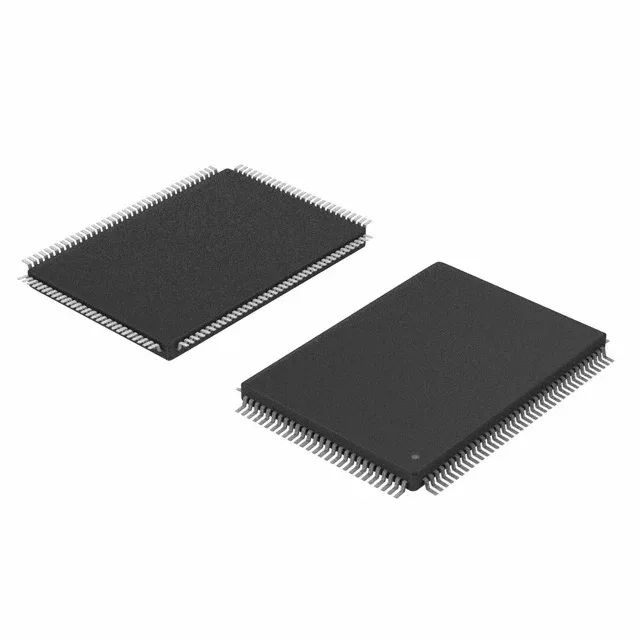
STMicroelectronics STM32G484QET6 — Microcontrollers & Processors (MCU / MPU / DSP)

STM32G484QET6 STM32G4 MCU, 170 MHz Cortex-M4, 512 KB Flash

MPNSTM32G484QET6
Active

STMicroelectronics STM32G4 series ARM Cortex-M4 32-bit MCU, 170 MHz, 512 KB FLASH, 128 KB RAM, 107 I/O, 42x12-bit ADC, 4x12-bit DAC, CANbus, QSPI, USB, 128-LQFP (14x14 mm), -40 to 85°C.

$11.1700Ref. price · indicative, final on quote
Packaging128-LQFP
RoHSROHS3 Compliant
SeriesSTM32G4
Independent supplier — new & surplus stockAuthenticity-screened · ESD-safe packingListing updated Aug 2026

Specifications

STM32G484QET6 specifications
ParameterValue
SeriesSTM32G4
MountingSurface Mount
Oscillator typeInternal
Program memory typeFLASH
Voltage - supply (Vcc (Vdd))1.71V ~ 3.6V
Operating temperature-40°C ~ 85°C (TA)
Speed170MHz
PackageTray
RAM size128K x 8
Core size32-Bit Single-Core
PeripheralsBrown-out Detect/Reset, DMA, I²S, POR, PWM, WDT
ConnectivityCANbus, I²C, IrDA, LINbus, QSPI, SAI, SPI, UART/USART, USB
Number of i (O)107
Core processorARM® Cortex®-M4
Case128-LQFP
Data convertersA/D 42x12b; D/A 4x12b
Program memory size512KB (512K x 8)

Product details

170 MHz Cortex-M4 with FPU — throughput for mixed-signal control

The STM32G484QET6 runs an ARM Cortex-M4 core at 170 MHz with a single-cycle multiply and hardware floating-point unit — the 213 DMIPS ceiling is enough for real-time motor-field-oriented control loops, digital-power PFC algorithms, or multi-axis servo interpolation without an external DSP. On-chip memory pairs 512 KB of flash with 128 KB of SRAM; the flash uses a 4-way set-associative prefetch buffer to keep the core fed at full clock speed without wait-state penalties on sequential code. The 42-channel 12-bit ADC bank samples simultaneously across up to three converters — useful for reading three-phase motor currents plus a DC-link voltage in one conversion cycle. The four 12-bit DAC channels output analog setpoints or reference voltages without external converters.

Peripheral mix and connectivity for fieldbus and instrumentation

Connectivity includes CANbus (two FD-capable controllers), QSPI for external flash or RAM expansion, SAI for digital audio, and a full-speed USB device/host/OTG interface — enough to build a CANopen fieldbus node that logs data to an external NOR flash and streams it over USB. The 107 general-purpose I/O pins are multiplexed across the 128-LQFP package; most are 5 V-tolerant, so level translation is optional when interfacing to legacy 5 V logic or sensor rails. On-chip brown-out detect, power-on reset, and a windowed watchdog reduce the external supervisor count to zero for most designs — the BOR threshold is programmable from the flash option bytes.

The package ships in a tray — no reel or tape; plan for a tray feeder or manual placement in the pick-and-place setup.

Frequently asked questions

What is the STM32G484QET6's core speed and how does it affect control-loop performance?

The Cortex-M4 core runs at 170 MHz with a single-cycle multiply and hardware FPU. At that clock rate, a 16-kHz current-control loop with a full Clarke/Park transform and PI regulator completes in under 2 µs, leaving the remaining cycles for commutation sequencing and communications.

Can the STM32G484QET6 replace the STM32L151CBU6A on an existing board?

No — the STM32L151CBU6A uses a Cortex-M3 core in a 32-pin package with 37 I/O, while the G4 part is a Cortex-M4 in a 128-pin LQFP with 107 I/O. The pinout, supply voltage range, and peripheral set are different; a board redesign is required.