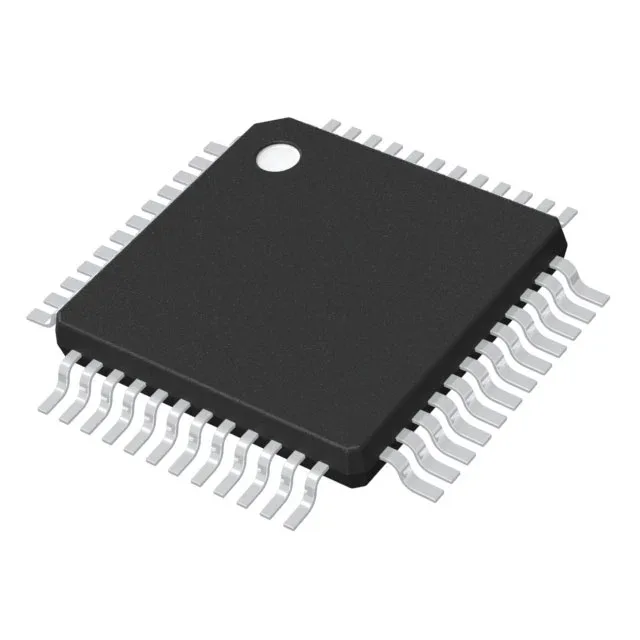
STMicroelectronics STM32G484CET6 — Microcontrollers & Processors (MCU / MPU / DSP)

STM32G484CET6 STMicroelectronics ARM Cortex-M4 MCU, 170MHz

MPNSTM32G484CET6
Active

STMicroelectronics STM32G4 series, STM32G484CET6, ARM Cortex-M4 32-Bit Single-Core MCU, 170MHz, 512KB Flash, 128K x 8 RAM, 48-LQFP, -40°C~85°C.

$6.9448Ref. price · indicative, final on quote
StockContact for availability
MOQ1 pcs
  • 100% new & originalTraceable channels only — no refurbs, no pulls, no remarked parts.
  • Date & lot codes on quoteStated per line before you commit; label photos on request.
  • MSL-compliant ESD packingMoisture-sealed bags with indicator cards; reels photo-verified.
  • PayPal buyer protectionPay by T/T, PayPal or Payoneer — card payments covered end to end.

Specifications

STM32G484CET6 Technical Specifications
ParameterValue
SeriesSTM32G4
Mounting typeSurface Mount
Oscillator typeInternal
Program memory typeFLASH
Voltage - supply (Vcc (Vdd))1.71V ~ 3.6V
Operating temperature-40°C~85°C(TA)
Speed170MHz
PackageTray
RAM size128K x 8
Core size32-Bit Single-Core
PeripheralsBrown-out Detect/Reset, DMA, I²S, POR, PWM, WDT
ConnectivityCANbus, I²C, IrDA, LINbus, QSPI, SAI, SPI, UART/USART, USB
Number of i (O)38
Core processorARM® Cortex®-M4
Case48-LQFP
Data convertersA/D 20x12b; D/A 4x12b
Program memory size512KB (512K x 8)

Product details

Mixed-signal MCU for field-oriented motor control and digital power

The 48-LQFP package (7x7 mm body) keeps the board footprint compact for drives, power tools, and digital power supplies where every square millimeter counts. What distinguishes this part from a plain Cortex-M4 is the analog peripheral set: 20 channels of 12-bit ADC and four 12-bit DAC channels, letting it sample multiple phase currents and output analog references without external converters. The connectivity block includes CANbus, I²C, SPI, QSPI, UART/USART, USB, and SAI for audio or serial-interface peripherals, making it a single-chip controller for inverter stages that also talk to a host or fieldbus.

The 170 MHz core speed is the headline number that drives the control-loop budget. For a 20 kHz current-control loop with sensorless observer, each microsecond of margin matters — the 170 MHz clock gives roughly 170 instruction cycles per microsecond, enough to run a full FOC transform, PI regulators, and SVPWM update within a 50 µs PWM cycle. The Cortex-M4 FPU handles the trig and matrix math in hardware, so the firmware team does not need to hand-optimise fixed-point routines. If the application needs an OTA staging area, the 512 KB leaves room for a dual-bank scheme without external memory.

48-LQFP — pinout and board integration

The 48-LQFP package with a 7x7 mm body exposes 38 I/O lines. That is enough for a three-phase inverter with Hall/encoder feedback, a CAN transceiver interface, a UART debug port, and a few spare GPIOs for fault indicators or auxiliary relays. The LQFP footprint is hand-solderable for prototypes and reflow-friendly for production. If the design needs 125°C junction capability, the STM32G4 family offers a 105°C variant in the same pinout; check the base number suffix.

Active lifecycle — no near-term LTB risk

STMicroelectronics lists the STM32G484CET6 as Active. There is no announced last-time-buy or end-of-life notice on this base product number. The STM32G4 series is a relatively recent addition to ST's portfolio, so roadmap support for new designs is solid — no need to qualify a second source for lifecycle reasons alone.

Frequently asked questions

What is the difference between STM32G484CET6 and STM32G484RET6?

The difference is the package and pin count. The STM32G484CET6 comes in a 48-LQFP with 38 I/O, while the STM32G484RET6 uses a 64-LQFP with more I/O lines and a larger body size. The core, memory, and peripheral set are identical — the choice depends on how many external signals the design needs to route.