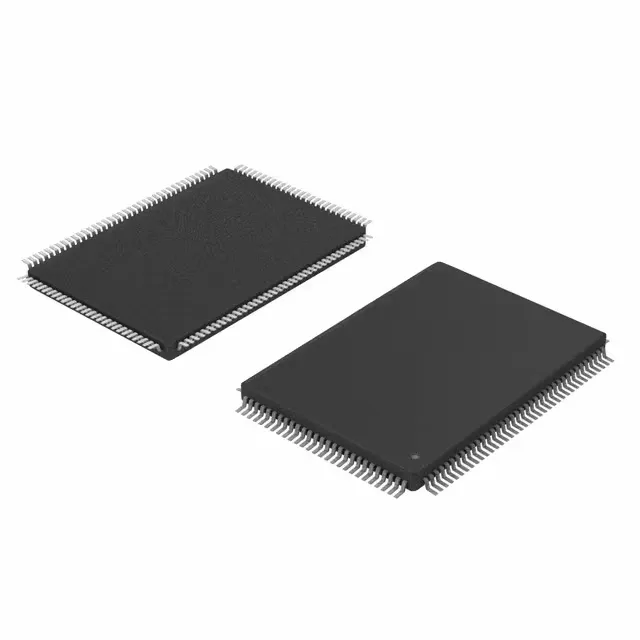
170 MHz Cortex-M4F — what the core speed buys you
At 170 MHz the Cortex-M4F can execute a single-cycle multiply-accumulate or a hardware divide, which matters for the inner loops of a field-oriented motor controller or a digitally controlled power converter. The FPU handles trigonometric and division operations without software emulation, so the same clock delivers more useful throughput per MHz than a Cortex-M3 at a comparable frequency. The 128 KB SRAM is sized to hold a full set of motor phase currents, rotor position, and a PID state vector without spilling to Flash.
Analog integration: 42 ADC channels, 7 DAC channels
The 42x12-bit ADC channels cover three separate SAR ADCs that can sample simultaneously, which is the typical requirement for three-phase motor current sensing plus a DC-link voltage measurement in one conversion window. The 7x12-bit DAC channels can generate analog references or offset trim voltages for external comparators and op-amps. Combined with the built-in comparators and operational amplifiers in the STM32G4 peripheral set, this part can close a current-control loop entirely on-chip.
Connectivity and peripheral set for system integration
The 107 general-purpose I/O pins in the 128-LQFP package leave room for parallel sensor arrays, external memory buses, or a human-machine interface. Brown-out detection, power-on reset, DMA, and a watchdog timer are built in, reducing external supervisor IC count.
No last-time-buy risk is present today.