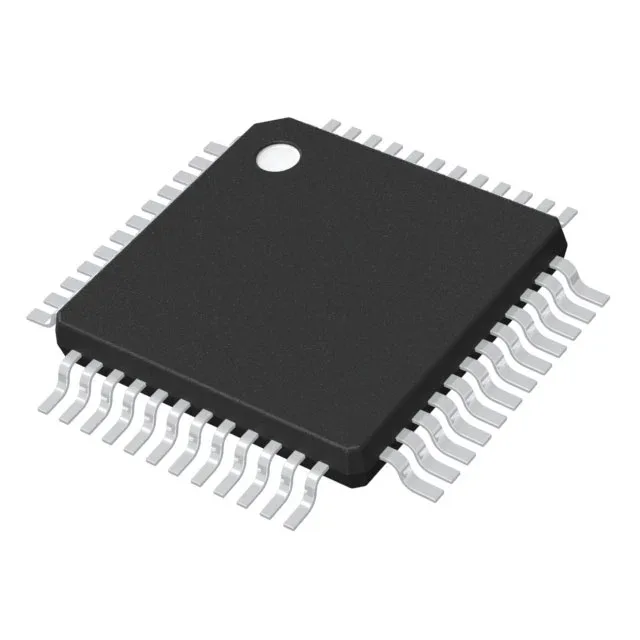
The core runs at 170 MHz with a single-precision FPU, and the part carries 128 KB of Flash and 128K x 8 SRAM — enough headroom for sensor fusion and field-oriented control loops without external memory. What sets this MCU apart is the analog peripheral density: 20 channels of 12-bit ADC and 7 channels of 12-bit DAC, paired with a high-resolution timer (HRTIM) that can generate complex PWM patterns down to 217 ps resolution.
128 KB Flash and 128K x 8 SRAM — sizing the firmware and data buffers
The 128 KB Flash program memory is matched to the 128K x 8 SRAM, giving balanced storage for code and runtime data. For a typical motor-control application with a FOC algorithm, the firmware footprint fits comfortably with room for a bootloader and communication stacks. The SRAM handles the ADC result buffers, lookup tables, and state variables without overflow. If the application requires larger data arrays or over-the-air update staging, the G474 family offers higher-density siblings (256 KB and 512 KB Flash) in the same 48-LQFP footprint — a straightforward BOM migration path.
20x12b ADC and 7x12b DAC — analog channel count for multi-sensor designs
The 20-channel 12-bit ADC and 7-channel 12-bit DAC are the standout features for power-conversion and signal-conditioning applications. The ADC can sample multiple current-sense resistors and voltage dividers simultaneously, while the DACs provide reference levels or analog setpoints without external components.
Connectivity and peripherals for system integration
The MCU includes CANbus, I²C, IrDA, LINbus, QSPI, SPI, and UART/USART interfaces — enough for industrial fieldbus bridging, sensor networks, and human-machine interface links. The brown-out detect and reset, DMA, I²S, POR, PWM, and watchdog peripherals reduce external supervisory ICs and glue logic. The 38 general-purpose I/Os in the 48-LQFP package give enough pins for a typical mixed-signal control board with a few external sensors and a display.
For dual-sourcing or second-source planning, the STM32G474 family shares pin-compatible options across Flash density variants, allowing a BOM-level swap without a PCB respin.