170 MHz Cortex-M4F with FPU — real-time control target
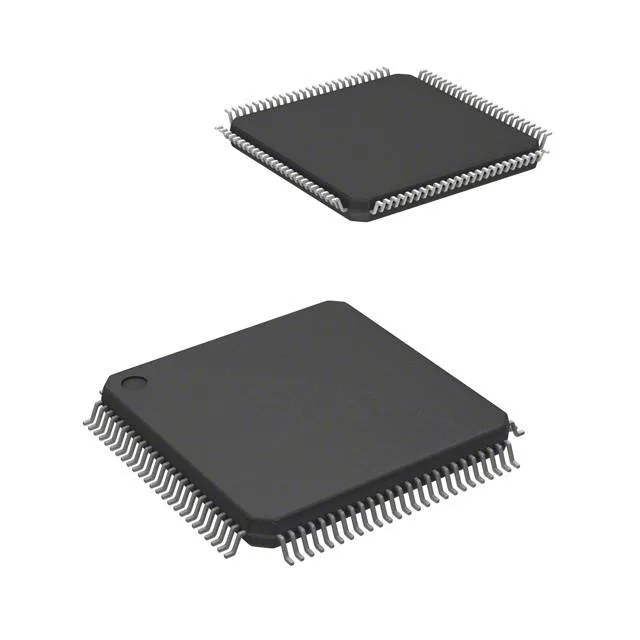
The 170 MHz core includes a single-precision FPU and DSP instructions, so a field-oriented control loop or a buck-converter compensator runs without an external DSP. Program memory is 128 KB of Flash; the 32 KB SRAM handles a pair of 256-point FFT buffers or a moderate real-time OS heap. The 100-LQFP package brings out 86 GPIOs, enough to interface with a resolver interface, multiple encoder channels, and a parallel LCD.
Analog integration: 23 ADC channels and four DACs
On-chip data converters include a 23-channel 12-bit ADC and a 4-channel 12-bit DAC. For a three-phase motor drive with current sensing on all legs plus a DC-link voltage monitor, the ADC channel count covers it without an external multiplexer. The four DAC outputs can generate analog reference voltages or feed setpoints to external analog isolators. Combined with the internal oscillator and the brown-out detect/POR, the BOM stays tight for a single-board servo drive or a digital PSU controller.
The I²S interface handles digital audio or synchronous serial data from a Σ-Δ modulator. DMA is available for all major peripherals, so the core can stay in sleep or run control loops while data moves in the background.
For a design that needs 105°C or 125°C, the STM32G4 family includes extended-temperature variants — verify the suffix before committing the BOM.
For dual-sourcing resilience, the STM32G4 series shares a common pinout across density options, so a drop-in migration to a higher-Flash sibling is possible without a board spin.