That core speed and the single-cycle MAC with FPU make it a fit for time-critical mixed-signal loops — digital power-supply control, field-oriented motor control, and real-time sensor fusion where the math has to settle before the next PWM cycle. On-chip analog integration includes 23 channels of 12-bit ADC and four channels of 12-bit DAC, so a typical sensor-to-actuator path — read three phase currents, compute the Park/Clarke transform, update the timer compare registers — stays inside one package without external converters. Program memory is 128 KB of Flash, paired with 32 KB SRAM. That memory footprint covers mid-complexity firmware: a motor-control stack with field-weakening, a digital PFC loop, or a CANopen application stack with room for a bootloader.
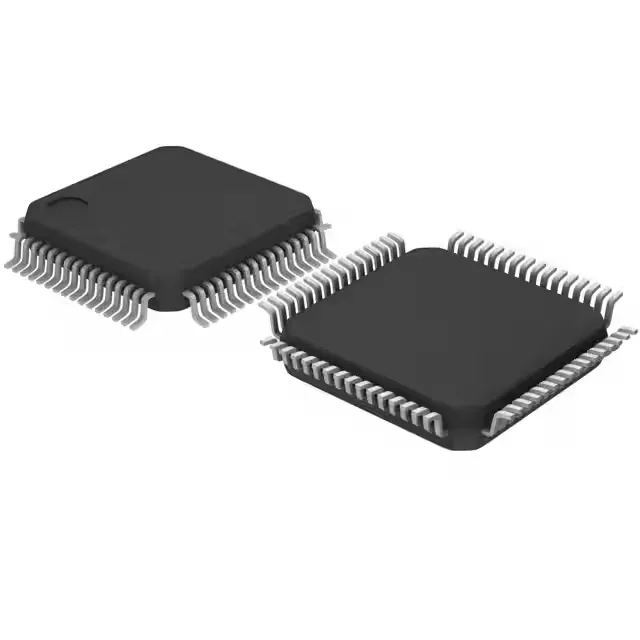
The 64-LQFP package (10x10 mm body) with 52 accessible I/O gives enough GPIO for a three-shunt inverter interface, encoder inputs, and a UART/CAN debug link without multiplexing conflicts.
For a production BOM being qualified today, this part does not carry the obsolescence risk that drives a respin six months after launch. The base product number is STM32G431, which shares pin-compatibility across the STM32G4x1 value-line density options. If a design later needs more Flash or a different peripheral set, the migration path stays within the same 64-LQFP footprint without a board layout change.