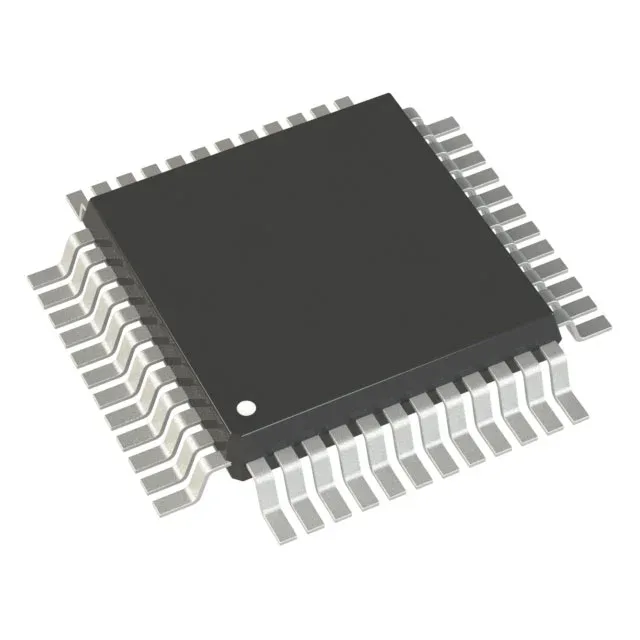
USB Type-C PD — no external PHY needed
The STM32G071KBT6 includes a USB Type-C and Power Delivery controller as a built-in peripheral, supporting the full PD specification over the CC lines. This means a single-chip USB-C sink or DRP implementation without a separate PD PHY or TCPC — the MCU handles the negotiation directly. For designs that need to charge from or negotiate power with a USB-C source, this peripheral integration is the main differentiator versus older STM32 families.
The 128 KB Flash (128K x 8) and 36 KB RAM (36K x 8) define the application space. The Flash is sufficient for moderate-complexity control firmware with USB-PD stack, while the RAM handles two or three moderate-size buffers plus the stack and heap. If the application needs more than 36 KB of runtime data — for example, large frame buffers or extensive lookup tables — the part will run out of RAM; the next step up in the STM32G0 line offers higher RAM options in the same package footprint.
The STM32G0 series is ST's mainstream low-power Cortex-M0+ family, positioned for volume production through 2030.
Analog integration — 13-ch 12-bit ADC, dual 12-bit DAC
The on-chip data converters include a 13-channel 12-bit successive-approximation ADC and two 12-bit DAC channels. The ADC can sample up to 13 external analog signals — enough for monitoring multiple sensor inputs, potentiometers, or current-sense voltages in a motor-control or power-conversion application. The dual DACs can generate analog setpoints or reference voltages without external DAC ICs, saving board area and cost.