64 MHz Cortex-M0+ — what it buys you
The 64 MHz clock on the Cortex-M0+ core gives enough throughput for real-time loops like 10 kHz PID updates, UART polling at 1 Mbps, or driving a PWM waveform without a dedicated timer interrupt. The core is single-cycle multiply but not hardware divide — keep division-heavy math on the peripheral side or precompute in the compiler. Flash wait-state insertion kicks in above 48 MHz; the STM32G0's prefetch buffer helps but budget a cycle penalty on random-access code at full speed.
Memory and peripheral fit
64 KB Flash and 18 KB SRAM are the entry-level sweet spot for firmware that fits a bootloader, a communication stack (I²C, SPI, UART), and a modest application layer. The 18 KB SRAM leaves room for a couple of 1 KB FIFO buffers plus a 4 KB stack — enough for a Modbus RTU slave or a BLE command bridge. The 12-bit SAR ADC and two 12-bit DAC channels handle basic analog front-end tasks without an external converter.
Temperature grade and operating conditions
The 1.7 V minimum supply lets it run through a battery's end-of-life voltage, and the 3.6 V maximum covers the upper end of a 3.3 V rail with margin. Brown-out detect and POR are integrated, so you can skip the external supervisor in many designs.
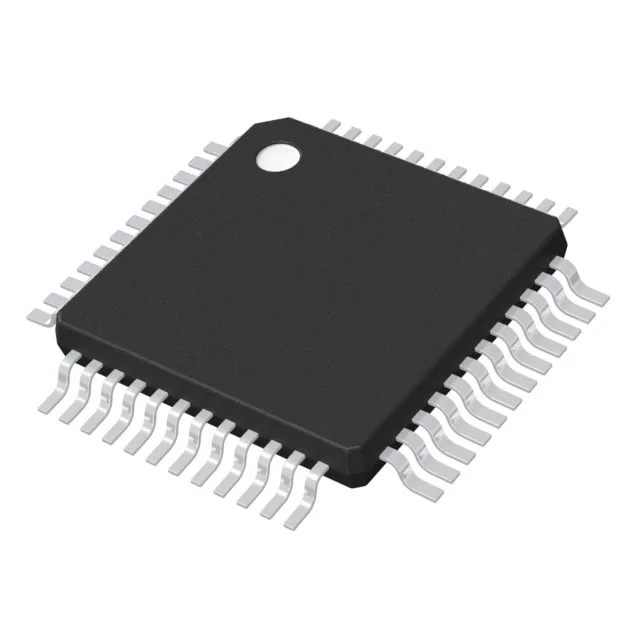
Listed as Active by STMicroelectronics with ROHS3 compliance. For dual-sourcing or a higher-performance sibling, the STM32G0 series includes pin-compatible options with up to 128 KB Flash — a straight swap on the same 48-LQFP footprint if firmware fits.