The part is built for cost-sensitive, space-constrained embedded control — think sensor nodes, motor control, power-management auxiliaries, and simple HMI panels where a full-featured Cortex-M4 would be overkill.
64 MHz Cortex-M0+ — enough for most control loops
The 64 MHz core speed on the Cortex-M0+ delivers about 0.95 DMIPS/MHz, so you get roughly 60 DMIPS of integer throughput. That handles a 10 kHz current-control loop with headroom for comms stack overhead. For comparison, the same core at 48 MHz would leave about 25% less margin for the same task — the 64 MHz rating is the one to spec if your interrupt latency budget is tight.
It fits a modest application: a bootloader plus one or two application images if you use over-the-air update staging, or a single firmware blob with a few KB left for parameter tables. The 8 KB SRAM is tight for buffering — plan to use DMA (the part has a DMA controller) to move data between peripherals and memory without CPU stalls. If your application needs a larger heap or multiple large buffers, step up to the 128 KB Flash / 36 KB RAM variants in the same package.
Connectivity and analog peripherals
The 17-channel 12-bit ADC covers analog inputs like thermistors, potentiometers, or current-sense resistors without an external converter.
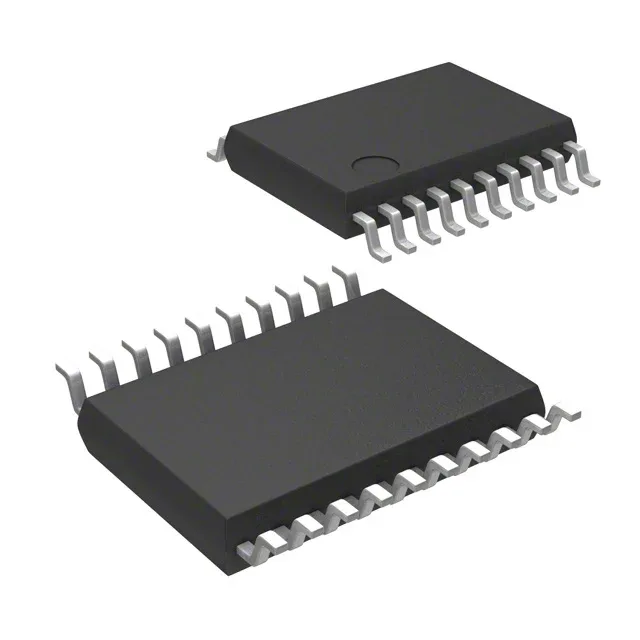
Housed in a 20-TSSOP (4.40 mm body width), this MCU fits on a two-layer board without blind vias. No exposed pad — all dissipation goes through the leads, so keep the ambient below 85°C if you run the I/O pins near their DC current limits. The tube shipping medium means the parts arrive aligned for pick-and-place; if you need tape-and-reel for high-volume reels, order the 'TR' suffix variant.