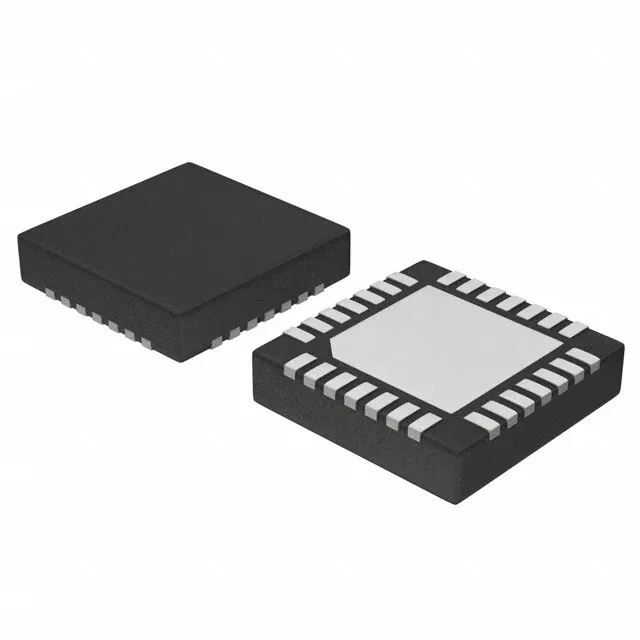
The STM32G031G8U6: The mistake this part avoids: grabbing a bigger Cortex-M4 or M3 part with more flash than the firmware needs, burning board area and BOM cost. For a sensor node, a motor controller, or a simple HMI, this is the right tier.
At 64 MHz the Cortex-M0+ core can handle real-time control loops, UART polling at 115200 baud without a FIFO overflow, and basic DSP math for filtering. The 8 KB of RAM (8K x 8) is tight — budget about 4 KB for the stack and heap, leaving 4 KB for data buffers.
The 1.7 V minimum lets this MCU run directly from a single alkaline or Li-ion cell down to near-empty. The 3.6 V maximum covers the 3.3 V rail with headroom. No external LDO needed for most battery-powered designs, which saves a component and a decoupling cap.
26 I/O in a 4x4 mm QFN — layout reality
The 28-UFQFPN package (4x4 mm) puts 26 general-purpose I/O on a very small footprint. That is dense routing — expect to use micro-vias or at least 0.2 mm trace/space on a two-layer board.
Active lifecycle — no LTB worry
ROHS3 compliant.