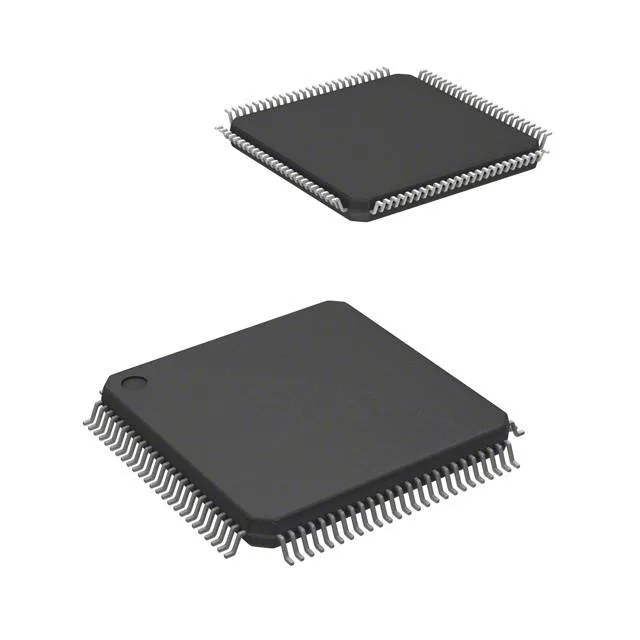
Its 216 MHz core clock and 2 MB of on-chip Flash place it in the performance tier that handles real-time control loops, Ethernet packet processing, and graphics frame buffers from a single chip. The 512K x 8 SRAM gives enough headroom for double-buffered display data or a TCP/IP stack without external memory.
Connectivity and peripherals — what fits on the bus
This part carries a full industrial-connectivity set: Ethernet MAC, two CAN interfaces, USB OTG (host and device), multiple SPI and I²C channels, plus an SDIO/SD card interface. The 82 GPIOs in the 100-LQFP package leave enough pins free for a parallel LCD or an external memory bus (EBI/EMI) alongside the serial interfaces. The internal oscillator can serve as the system clock for non-critical timing, but the 216 MHz PLL will need an external crystal or oscillator for accurate Ethernet or USB operation.
It suits factory automation controllers, outdoor telecom equipment, motor drives, and engine-bay-adjacent electronics where the board sees temperature swings but not the full 125°C automotive under-hood soak.
Listed as Active with an ROHS3 compliance status. For BOM planning, the STM32F7 series is a mature, widely-sourced family, so second-sourcing risk is low.
Supplied in a 100-LQFP (14x14 mm) body, surface-mount. For 216 MHz operation with Ethernet and USB active, plan for a 4-layer PCB with a solid ground plane and adequate decoupling near the VDD/VSS pairs.