216 MHz — what the core speed means for real-time control and throughput
At 216 MHz, the Cortex-M7 can sustain single-cycle multiply-accumulate operations and has a six-stage pipeline with branch prediction. For a motor-control loop running a field-oriented control algorithm at 20 kHz, this leaves enough headroom to also handle Ethernet communication and a user interface without a second MCU. The 216 MHz clock also drives the internal oscillator, so no external crystal is required for the core timing — though the internal oscillator's accuracy (±1% typical) should be checked against the application's timing budget.
1 MB Flash and 512 KB SRAM — memory sizing for firmware and data buffers
The 1 MB Flash is organized as 1M x 8 bits, which is enough for a full-featured RTOS, a TCP/IP stack, and a modest GUI library. The 512 KB SRAM (512K x 8) can hold several camera frames at VGA resolution or a large audio buffer for SPDIF output. If the application needs more RAM, the EBI/EMI interface on the connectivity list can drive external SRAM or SDRAM. The Flash is rated for 10,000 erase/write cycles per sector — adequate for field-upgradeable firmware with wear-leveling in the bootloader.
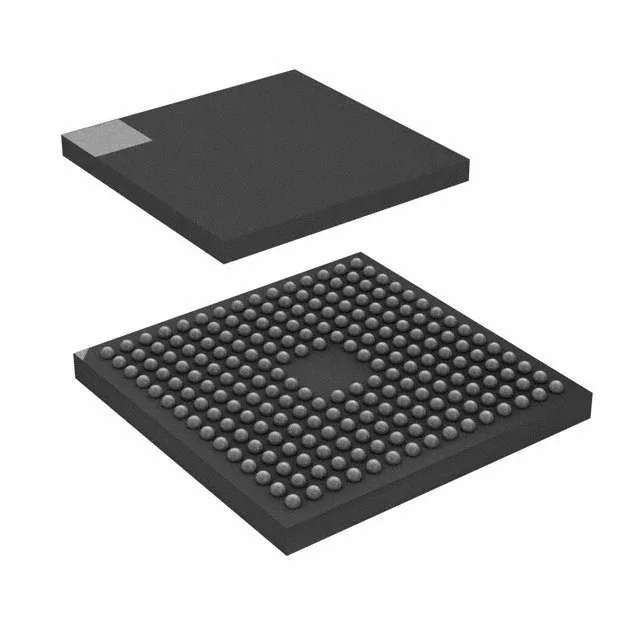
216-TFBGA — what the package demands from the PCB layout
The 168 I/O signals include multiple high-speed interfaces — Ethernet RMII, USB OTG HS, QSPI at up to 133 MHz — so signal-integrity rules for trace length matching and impedance control apply. The package is surface-mount only; no socketed prototyping. A four-layer board with a dedicated ground plane is the practical minimum for this density.
Connectivity and peripherals — Ethernet, CAN, USB, and more
The STM32F767NGH6 includes a full set of wired interfaces: Ethernet MAC (with external PHY), two CAN 2.0B controllers, USB OTG HS and FS, multiple SPI and I²C ports, and an SPDIF receiver interface for digital audio. The LCD parallel interface can drive a TFT display directly. For data storage, the MMC/SD/SDIO interface connects to external SD cards.
The STM32F7 series is a mainstream high-performance family that continues to receive firmware updates through STM32CubeMX and the HAL library. For a production BOM, this means no last-time-buy pressure and no forced redesign in the near term.