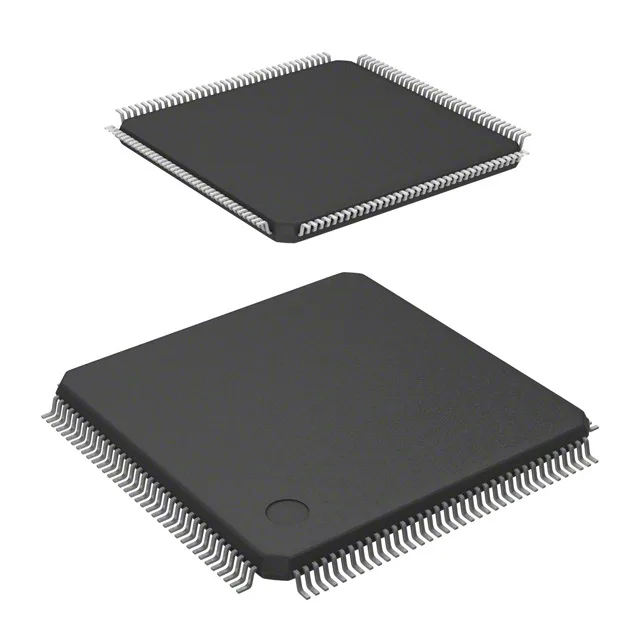
STMicroelectronics STM32F765ZIT7 — Microcontrollers & Processors (MCU / MPU / DSP)

STM32F765ZIT7 MCU, ARM Cortex-M7, 216 MHz, 2 MB Flash

MPNSTM32F765ZIT7
Active

STMicroelectronics STM32F7 series, STM32F765ZIT7, ARM Cortex-M7 32-Bit Single-Core MCU, 216 MHz, 2 MB Flash, 512K x 8 RAM, 114 I/O, 144-LQFP, -40°C to 105°C.

$20.5100Ref. price · indicative, final on quote
Packaging144-LQFP
RoHSROHS3 Compliant
SeriesSTM32F7
Independent supplier — new & surplus stockAuthenticity-screened · ESD-safe packingListing updated Aug 2026

Specifications

STM32F765ZIT7 specifications
ParameterValue
SeriesSTM32F7
MountingSurface Mount
Oscillator typeInternal
Program memory typeFLASH
Voltage - supply (Vcc (Vdd))1.7V ~ 3.6V
Operating temperature-40°C ~ 105°C (TA)
Speed216MHz
PackageTray
RAM size512K x 8
Core size32-Bit Single-Core
PeripheralsBrown-out Detect/Reset, DMA, I²S, POR, PWM, WDT
ConnectivityCANbus, EBI/EMI, Ethernet, I²C, IrDA, LINbus, MMC/SD/SDIO, QSPI, SAI, SPDIF, SPI, UART/USART, USB OTG
Number of i (O)114
Core processorARM® Cortex®-M7
Case144-LQFP
Data convertersA/D 24x12b; D/A 2x12b
Program memory size2MB (2M x 8)

Product details

ARM Cortex-M7 at 216 MHz — what the core speed buys you

The STM32F765ZIT7 is a 32-bit single-core MCU built around the ARM Cortex-M7 core running at 216 MHz. That clock rate puts it in the high-performance tier of the STM32F7 family, well above the 32 MHz Cortex-M3 parts like the STM32L151 series. For firmware engineers, the 216 MHz PLL needs the flash prefetch and ART accelerator enabled before pushing past 200 MHz, or instruction-fetch stalls will eat the throughput gain. The core includes a single-precision FPU and a 6-stage pipeline with branch prediction — useful for real-time control loops and sensor fusion algorithms that would bog down a Cortex-M4.

2 MB Flash and 512 KB SRAM — memory budget for complex firmware

Program memory is 2 MB of Flash, organized as 2M x 8 bits. That is enough space for a full TCP/IP stack, a graphics library driving a QVGA display, and a bootloader with OTA staging area — no external SPI Flash needed for the main image. The 512 KB SRAM (512K x 8) handles Ethernet packet buffers, audio sample arrays, and multiple protocol stacks simultaneously without thrashing. If you are porting a legacy STM32F1 or STM32F4 project, the extra RAM headroom means you can keep more state in memory rather than swapping to external storage.

Connectivity and I/O — Ethernet, CAN, USB OTG, and 114 GPIOs

Package and footprint — 144-LQFP (20x20 mm)

The 144-LQFP package measures 20x20 mm with 0.5 mm pitch. That is a standard QFP footprint — no hidden thermal pad, no BGA rework challenges.

STMicroelectronics lists the STM32F765ZIT7 as an active product with ROHS3 compliance.

Frequently asked questions

What is the flash memory size of STM32F765ZIT7?

The STM32F765ZIT7 has 2 MB of Flash program memory, organized as 2M x 8 bits.

What is the core processor of STM32F765ZIT7?

It uses an ARM Cortex-M7 core, 32-bit single-core architecture, running at up to 216 MHz.

How many I/O pins does STM32F765ZIT7 have?

The device provides 114 I/O pins in the 144-LQFP package.

What package does STM32F765ZIT7 come in?

It is supplied in a 144-LQFP package (20x20 mm body, 0.5 mm pitch), surface-mount.