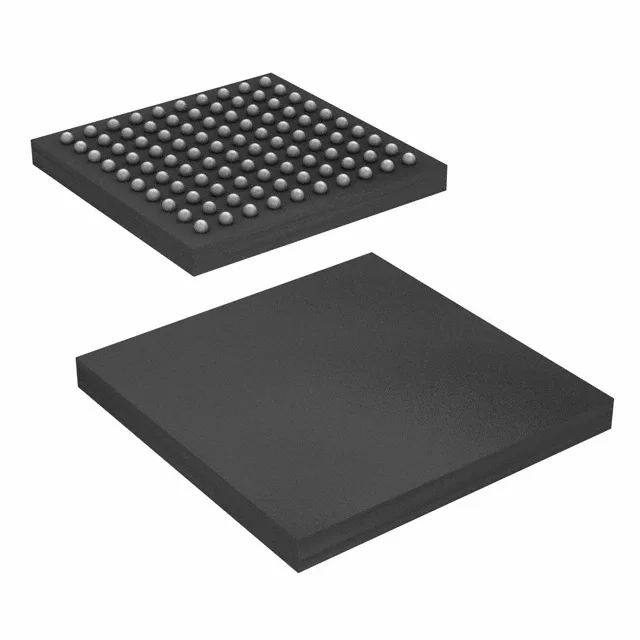
The STM32F733VEY6TR is a 32-bit ARM Cortex-M7 MCU from STMicroelectronics' STM32F7 series, clocked at 216 MHz. The 79 I/O lines are the practical constraint on peripheral count. You get CANbus, multiple I²C and SPI ports, a QSPI for external Flash, and a parallel EBI/EMI bus for an external SRAM or FPGA.
On-chip data converters and peripherals
The part integrates 24 analog inputs multiplexed into a 12-bit ADC and two 12-bit DAC outputs — enough for a six-axis IMU readout plus four auxiliary sensor channels, or for generating a pair of analog setpoints. The internal oscillator and brown-out detect circuitry reduce external BOM count, though a precision application will still want an external crystal for the USB or CAN clock.