216 MHz Cortex-M7 — what the core speed means for the BOM
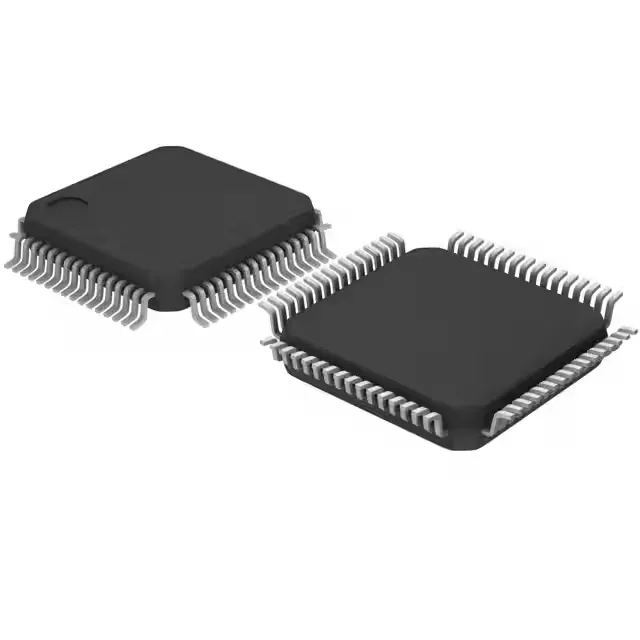
The STMicroelectronics STM32F732RET6 is a 32-bit ARM Cortex-M7 single-core MCU from the STM32F7 series, clocked at 216 MHz. That 216 MHz is the ceiling for this part — the real decision is whether your control loop or protocol stack can close timing with the 512 KB Flash and 256 KB SRAM on-chip. For a motor-drive FOC loop or an HMI with Ethernet-to-PLC bridging, the Cortex-M7 DSP extension and single-precision FPU handle the math without an external coprocessor. The 50 I/O in a 64-LQFP (10x10 mm) footprint keeps the board area tight enough for compact drives and sensor-interface cards. Operating from 1.7 V to 3.6 V at -40 to 85 °C, it fits industrial enclosures and outdoor telecom cabinets without a secondary regulator.
Memory map and peripheral set — sizing the firmware and bus
512 KB Flash (512K x 8) and 256 KB SRAM (256K x 8) are the two numbers that decide whether this MCU runs your application or runs out of room. The Flash holds the firmware image — a Modbus TCP stack plus a basic HMI page buffer fits; a full embedded Linux-style GUI does not. The SRAM is shared between code execution, DMA buffers, and CAN / USB FIFOs. Connectivity includes CANbus, I²C, IrDA, LINbus, MMC/SD, QSPI, SAI, SPI, UART/USART, and USB — enough for a multi-protocol fieldbus gateway or a data-logging front-end. The 16-channel 12-bit ADC and dual 12-bit DAC cover analog sensor conditioning and closed-loop setpoint generation on the same die.