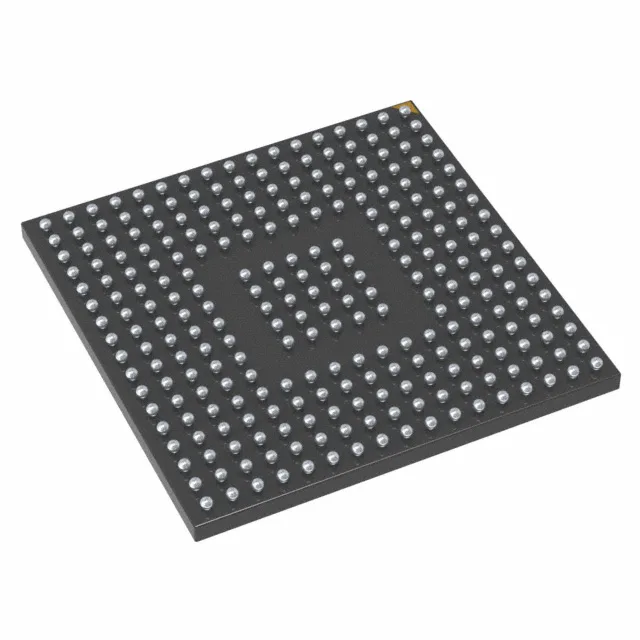
This is the part you pick when a mid-range Cortex-M4 starts running out of headroom on FFTs, motor-control loops, or Ethernet packet processing — the M7's single-cycle multiply-accumulate and hardware divide save real cycles on DSP math without stepping up to a dual-core or external memory.
Memory sizing — 512 KB Flash, 256 KB RAM
The 512 KB Flash and 256 KB RAM split is a practical mid-range profile. It fits a FreeRTOS application with a TCP/IP stack, a USB device stack, and a modest data-logging buffer without needing external SRAM. The 256 KB RAM is organized as 256K x 8, which gives the linker script a single contiguous block — no bank-switching headaches. If your firmware image is pushing 400 KB or your heap/stack budget exceeds 180 KB, you are in the territory where the STM32F746 or F7x7 series with 1 MB Flash becomes the safer call.
The peripheral list includes CANbus, EBI/EMI, I²C, IrDA, LINbus, MMC/SD, QSPI, SAI, SPI, UART/USART, and USB. The EBI/EMI interface lets you hang an external parallel NOR/NAND Flash or SRAM if the internal 512 KB is tight. QSPI gives a second memory-expansion path for serial Flash with execute-in-place capability.
Package and assembly — 201-UFBGA
The 10x10 mm footprint is compact for the I/O count — about half the board area of an equivalent LQFP-144. Reflow profile follows the standard lead-free SAC305 curve;