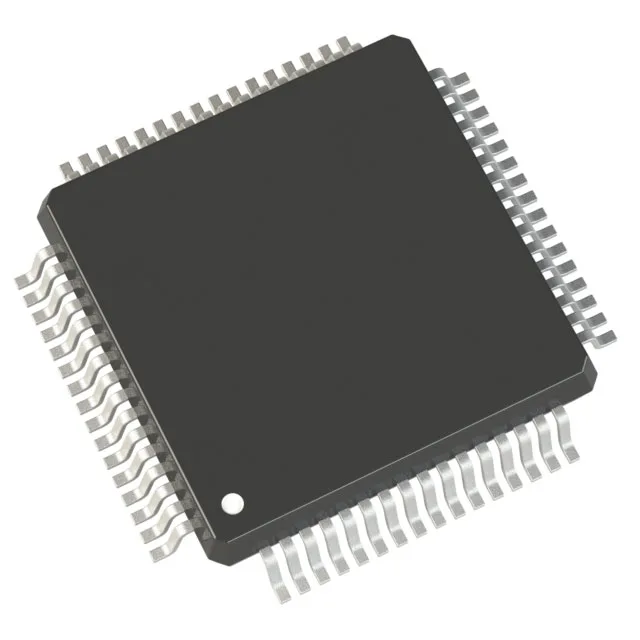
It is aimed at applications that need the M7's DSP and FPU throughput — motor control, industrial drives, audio processing, or real-time control loops — without the larger Flash densities of the upper STM32F7 tiers.
64 KB Flash — sizing the firmware budget
The 64 KB Flash (64K x 8) is the tightest constraint on this part. It fits a focused application — a single control loop with a modest RTOS, a CANopen stack, or a sensor-fusion algorithm — but leaves little room for a full TCP/IP stack, a GUI library, or over-the-air update staging. If the firmware is already sized, this part is a cost-effective fit; if the project expects to grow the code base, the STM32F730 family offers higher-density siblings without changing the core or package.
The STM32F730R8T6 includes CANbus, USB, QSPI, SAI, and an EBI/EMI interface for external memory or parallel peripherals. The two 12-bit DACs and sixteen 12-bit ADC channels cover analog I/O for sensor conditioning and actuator outputs. DMA and the internal oscillator reduce external component count.
ROHS3 compliant.