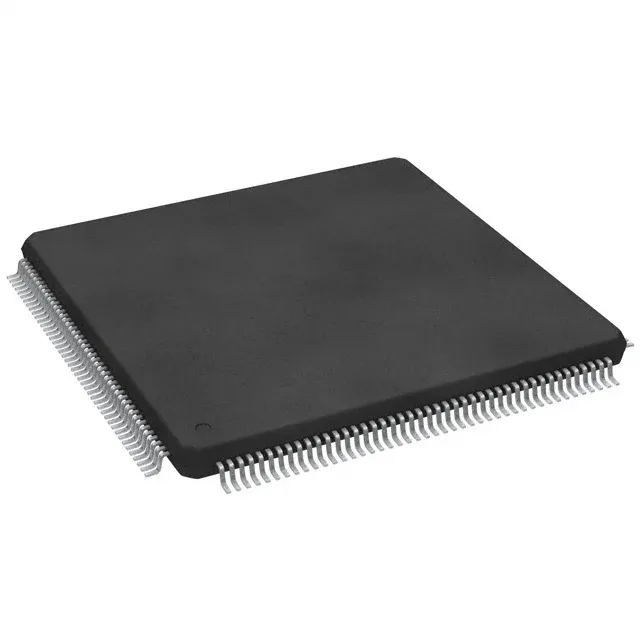
It is built for applications that need real-time signal processing, complex control loops, or rich HMI — think motor drives, industrial PLCs, embedded audio, and IoT gateways that push past what a Cortex-M4 can handle. The 176-LQFP package gives you 138 I/O lines, so you can wire up parallel displays, external memory buses, or a dense sensor array without multiplexing.
Memory and peripheral headroom
With 512 KB of program Flash and 256 KB of SRAM, this MCU can hold a FreeRTOS application with a TCP/IP stack, a basic GUI library, and still have room for data buffers. The 216 MHz core with a single-cycle multiplier and hardware divider means you are not waiting on the ALU for PID loops or FFT bins.
Package and rework — 176-LQFP reality
The 176-LQFP (24x24 mm body) is a hand-solderable package if you have a steady hand and a fine tip — no BGA rework station needed. The 0.5 mm pitch means you will want a solder stencil for production, but a single prototype board can be done with drag-soldering and a flux pen. Just make sure the PCB footprint matches the 24x24 mm land pattern; the supplier device package is exactly that.
It will sit comfortably in a factory automation cabinet, an outdoor telecom enclosure, or an engine-bay-adjacent module that sees under-hood heat soak but not direct exhaust. If you need 105°C or 125°C junction temperature, you would step up to the STM32F7 automotive-grade variants — this one is not AEC-Q100 listed.