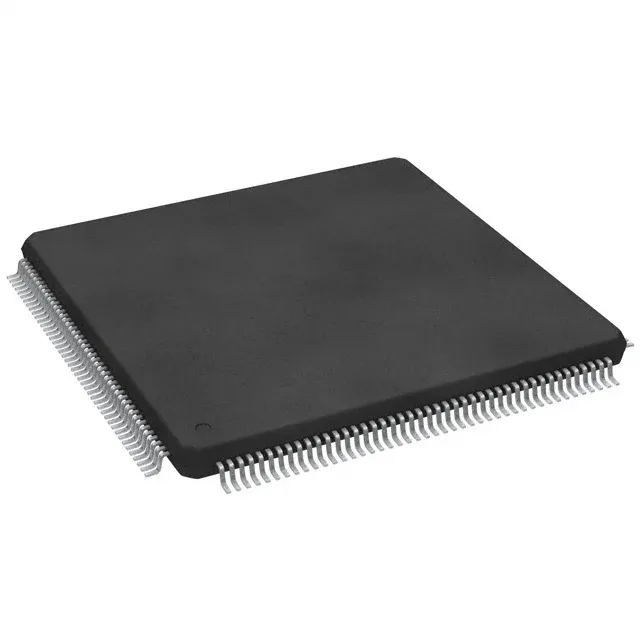
The STM32F722IET7 runs a single ARM Cortex-M7 core at 216 MHz, which puts it in the performance tier for motor-drive current loops, real-time Ethernet stacks, and DSP-style audio processing. That clock rate, combined with the 256 KB RAM, gives enough headroom for a FreeRTOS task set with a few hundred microseconds of ISR jitter budget — not a hard real-time FPGA replacement, but a solid fit for a multi-axis servo controller or a gateway aggregating several fieldbus segments.
512 KB of Flash and 256 KB of RAM are the mid-range option in the STM32F722 line. That Flash is enough for a moderate application stack — a TCP/IP stack, a file system, and a control algorithm — but if the firmware needs over-the-air update with a backup image, the 512 KB floor gets tight. The RAM covers a couple of large buffers for Ethernet frames or audio samples without external SRAM.
Connectivity and analog integration
This part includes an Ethernet MAC, which means you can run EtherCAT or PROFINET stacks without an external MAC chip — just add a PHY and magnetics. The 24-channel 12-bit ADC and dual 12-bit DAC cover most sensor-feedback and analog-output needs on a single chip, reducing the BOM count for a mixed-signal control board. The 140 I/O in the 176-LQFP package leave room for parallel memory, a display interface, and plenty of discrete signals.
Rated for -40 to 105 °C and 1.7 to 3.6 V supply range.