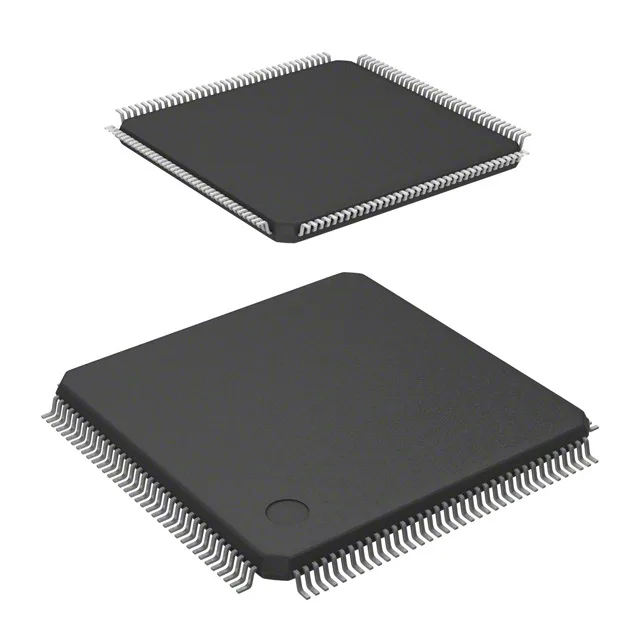
180 MHz Cortex-M4 with graphics and connectivity
It packs 512 KB of Flash and 384 KB of RAM, enough for moderate GUI stacks, protocol stacks, and real-time control loops. The integrated LCD controller with its own DMA engine offloads frame-buffer updates from the core — useful for 7-inch TFT panels without an external graphics controller.
Memory sizing and peripheral budget
512 KB Flash is the mid-density option in the STM32F469 line — enough for a FreeRTOS application with a TCP/IP stack and a basic GUI, but tight if you plan to store large font tables or image assets on-chip. The 384 KB SRAM splits across several banks (including 64 KB CCM-SRAM tightly coupled to the core), which helps with deterministic access for time-critical interrupt handlers. 106 GPIOs in the 144-LQFP package give headroom for a parallel RGB LCD interface, an external memory bus (EBI/EMI), and a handful of sensors or actuators without needing a port expander.
144-LQFP (20x20 mm) with 0.5 mm pitch — standard for hand-assembly rework and AOI inspection. No exposed pad on this package; thermal dissipation relies on the leadframe and board copper.
ST continues to manufacture the STM32F4 series, and this density/package variant is widely stocked across the independent distribution channel. For dual-sourcing resilience, the STM32F469ZET6 is pin-compatible with the STM32F429ZET6 — same 144-LQFP footprint, same supply range, same peripheral set minus the LCD-TFT controller (the F429 has a simpler LCD-TFT controller without the Chrom-ART accelerator). If your application relies on the graphics accelerator, the F469 is the correct choice; if not, the F429 offers a cost-reduction path with identical pinout.