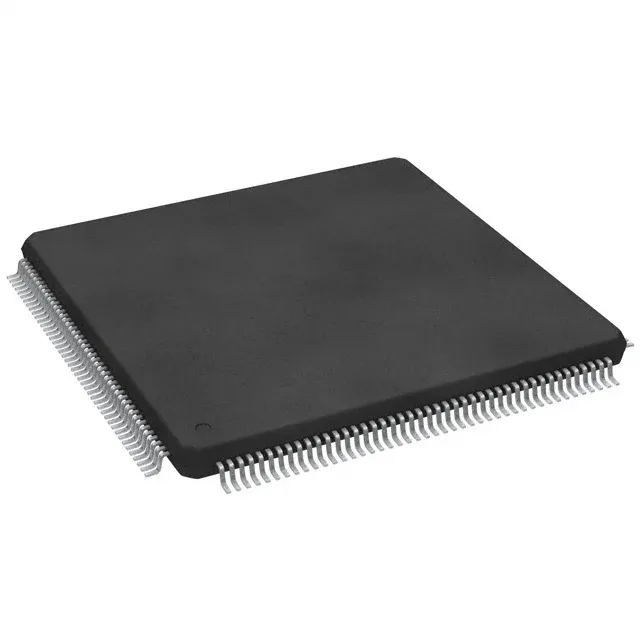
STMicroelectronics STM32F469IIT6 — Microcontrollers & Processors (MCU / MPU / DSP)

STM32F469IIT6 STM32 MCU, ARM Cortex-M4, 180 MHz, 2 MB Flash

MPNSTM32F469IIT6
Active

STMicroelectronics STM32F4 series, STM32F469IIT6, ARM Cortex-M4, 32-Bit Single-Core, 180 MHz, 2 MB Flash, 384K x 8 RAM, 176-LQFP, -40°C to 85°C.

$20.1700Ref. price · indicative, final on quote
Packaging176-LQFP
RoHSROHS3 Compliant
SeriesSTM32F4
Independent supplier — new & surplus stockAuthenticity-screened · ESD-safe packingListing updated Aug 2026

Specifications

STM32F469IIT6 specifications
ParameterValue
SeriesSTM32F4
MountingSurface Mount
Oscillator typeInternal
Program memory typeFLASH
Voltage - supply (Vcc (Vdd))1.7V ~ 3.6V
Operating temperature-40°C ~ 85°C (TA)
Speed180MHz
PackageTray
RAM size384K x 8
Core size32-Bit Single-Core
PeripheralsBrown-out Detect/Reset, DMA, I2S, LCD, POR, PWM, WDT
ConnectivityCANbus, EBI/EMI, Ethernet, I2C, IrDA, LINbus, SAI, SDIO, SPI, UART/USART, USB, USB OTG
Number of i (O)131
Core processorARM® Cortex®-M4
Case176-LQFP
Data convertersA/D 16x12b; D/A 2x12b
Program memory size2MB (2M x 8)

Product details

It carries 2 MB of Flash and 384 KB of SRAM, enough to run a GUI framework like TouchGFX or emWin directly, with room for a TCP/IP stack and application code. The 131 I/Os in a 176-LQFP package give you the pin count to drive a parallel RGB LCD, an external memory bus (EBI/EMI), and still have Ethernet, dual CAN, and USB OTG available.

180 MHz Cortex-M4 with FPU — where the speed matters

The 180 MHz core with hardware FPU and DSP instructions handles real-time control loops and floating-point math without a separate DSP. For an HMI panel running a 480x272 display with touch, the Chrom-ART Accelerator (DMA2D) offloads pixel blending and image copy from the CPU, so the 180 MHz budget goes to protocol handling and application logic rather than frame-buffer management.

Memory sizing for display and connectivity stacks

2 MB of Flash stores a full GUI library, font data, and the application binary without external Flash. The 384 KB SRAM splits between a frame buffer (a 480x272 16-bit display needs about 260 KB) and stack/heap for Ethernet and USB buffers. If the design needs more RAM, the EBI/EMI interface on this package variant connects to external SRAM or SDRAM without a glue-logic CPLD.

STMicroelectronics lists the STM32F469IIT6 as Active product status. This is a current-production part with no announced discontinuation or last-time-buy window. The STM32F469 series continues to receive firmware library updates and errata support from ST.

The 176-LQFP (24x24 mm) is a standard quad flat pack with 0.5 mm pitch, hand-solderable and inspectable.

Frequently asked questions

What is the maximum operating frequency of STM32F469IIT6?

The STM32F469IIT6 runs at 180 MHz from the ARM Cortex-M4 core with FPU. This is the maximum rated speed; the PLL and flash wait states must be configured accordingly in firmware.

Can STM32F469IIT6 replace STM32F469NIH6?

The STM32F469IIT6 and STM32F469NIH6 share the same core, memory, and peripheral set but differ in package. The IIT6 is a 176-LQFP (24x24 mm) with 131 I/Os, while the NIH6 is a 216-BGA. They are not pin-compatible — a board redesign is required to swap between them. Check the specific package variant your layout expects.

What is the equivalent of STM32F469IIT6?

The STM32L151CBU6A is a different family (STM32L1, Cortex-M3 at 32 MHz) with much lower Flash and I/O count — it is not a functional equivalent. Within the STM32F4 family, the STM32F469NIH6 (216-BGA) and STM32F469AIH6 (UFBGA) share the same core and memory but differ in package and I/O count. For a pin-compatible second source, there is no direct cross from another manufacturer; the STM32F469 series is the only source for this specific peripheral set and package.