180 MHz Cortex-M4 with 2 MB flash — what the ratings mean for the BOM
The STM32F439IIT6 is an STM32F4-series ARM Cortex-M4 MCU running at 180 MHz, with 2 MB of on-chip Flash and 256 KB SRAM. This is the high-end density variant in the STM32F4 line — the flash footprint holds a full RTOS, application stack, and file system without external memory, while the 256 KB SRAM gives the scheduler and data buffers room to breathe without cache-line thrashing. The 180 MHz clock rate is the core's ceiling — real throughput depends on flash wait states at that speed, but the Cortex-M4 with single-cycle multiply and hardware FPU means the 225 DMIPS figure (typical for this core at 180 MHz) is achievable for signal-chain math like FFT or motor-control observers without cycle-counting every multiply.
Connectivity and peripheral set — Ethernet, CAN, USB OTG, and parallel bus
The 140 I/Os in the 176-LQFP package give enough headroom to route a parallel TFT LCD interface alongside a 16-bit external memory bus and still have pins left for sensors and actuators. The 24-channel 12-bit ADC and dual 12-bit DAC cover analog front-end capture and control-loop output without an external converter. The ADC samples at up to 2.4 MSPS in interleaved mode — fast enough for current-sense in a motor drive or vibration monitoring on a production line.
Package, supply, and temperature grade — board-fit realities
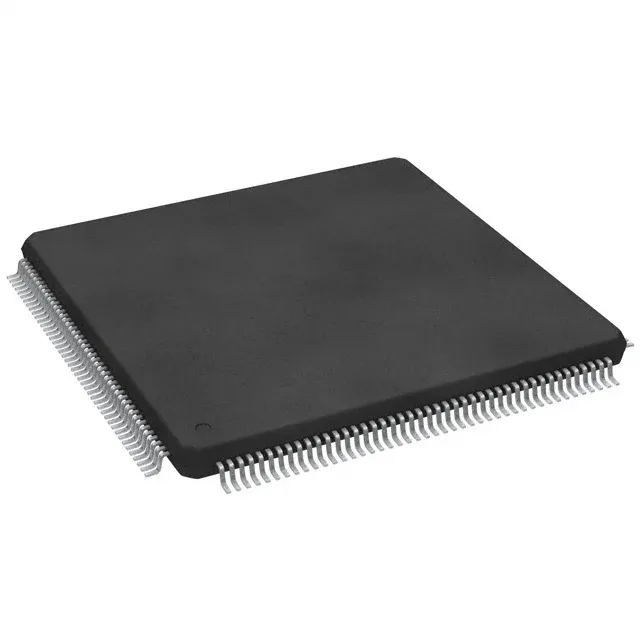
The 176-LQFP (24x24 mm) is a 0.5 mm-pitch quad flat pack — the outer rows fan out on a two-layer board, but the inner power/ground pads and the EBI/EMI bus traces will push a design to four layers for signal integrity. The internal oscillator and brown-out detect reduce external component count in these environments — no external resonator needed for the core clock, and the BOR resets the part cleanly on a supply sag.
The base product number is STM32F439, meaning the die, memory map, and peripheral set are shared across the F439 family — a BOM using the 144-pin or 208-pin sibling can migrate to this 176-pin variant with a PCB layout change but the same firmware binary, assuming the peripheral allocation is compatible.
Sourcing posture — quoted to order, traceable supply
Date-code and marking consistency are confirmed at the point of receipt — the laser-etched top mark on the STM32F4 series has a specific font and kerning that a counterfeit check verifies before the stock is allocated to a BOM. Pricing and lead time are confirmed at RFQ against the specific quantity and delivery window.