180 MHz Cortex-M4 with 2 MB Flash — what the spec means for your BOM
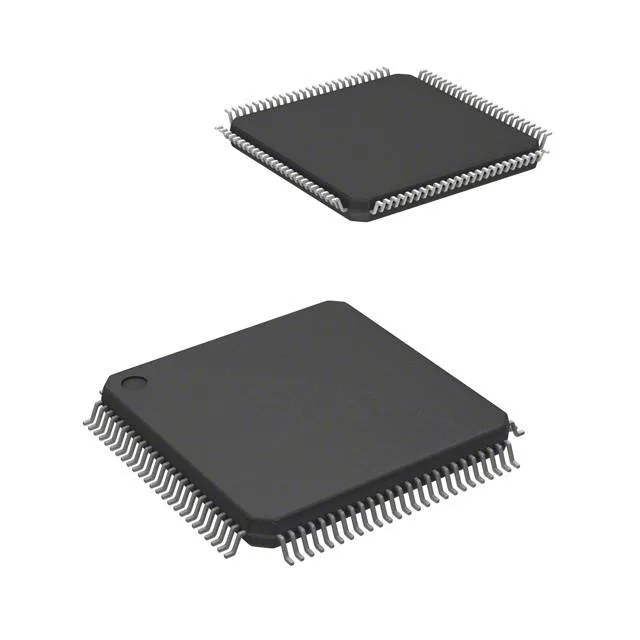
The STM32F427VIT7TR: 2 MB Flash and 256 KB SRAM in a 100-pin LQFP package. This MCU is used for deterministic real-time control — motor-drive FOC loops, Ethernet-connected PLCs, or multi-channel audio processing — and avoids the routing cost of a BGA. The 180 MHz core speed supports tighter loop times for current-control or sensor-fusion algorithms. The 2 MB Flash provides headroom for a full TCP/IP stack plus a bootloader with OTA staging. The 256 KB SRAM supports moderate frame buffers or a real-time OS with a handful of tasks.
Connectivity and peripheral set — what you can wire to it
This MCU carries Ethernet MAC, two CAN 2.0B interfaces, USB OTG HS/FS, and multiple SPI/I²C/UART channels. The 82 GPIOs are enough to drive a parallel LCD or an external memory bus via the flexible static memory controller (FSMC), though you'll need to check pin multiplexing if you plan to use all three high-speed interfaces simultaneously.
The industrial temperature range means you can use it in a single design across indoor and outdoor variants without requalifying a different temperature grade.
No BGA routing complexity — four-layer boards with a ground plane are sufficient.
For a production BOM that will run for three to five years, this MCU carries no imminent obsolescence risk. The STM32F4 series is a mature, high-volume platform with broad distribution coverage, so allocation pressure is lower than on newer, capacity-constrained nodes.