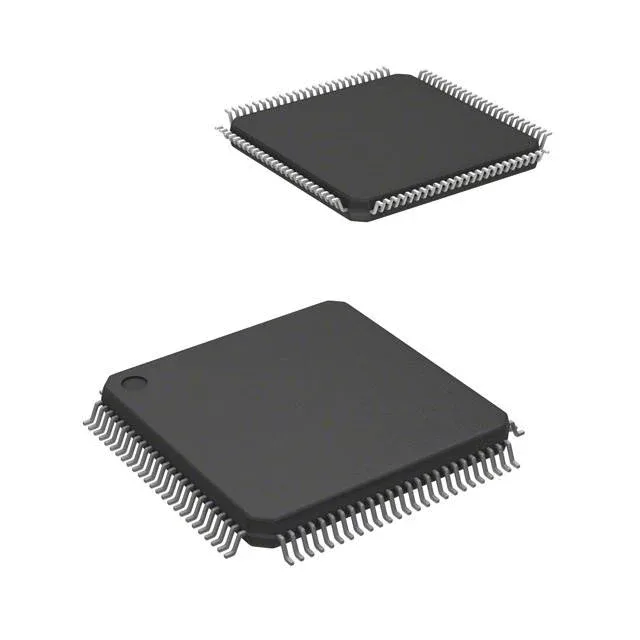
STMicroelectronics STM32F417VGT6TR — Microcontrollers & Processors (MCU / MPU / DSP)

ST STM32F417VGT6TR ARM Cortex-M4 MCU, 168 MHz, 1 MB Flash

MPNSTM32F417VGT6TR
Active

STMicroelectronics STM32F4 series STM32F417VGT6TR, ARM Cortex-M4 32-bit MCU, 168 MHz, 1 MB Flash, 192 KB RAM, Ethernet MAC, CAN, USB OTG, 82 I/O, 100-LQFP, -40°C to 85°C.

$17.4600Ref. price · indicative, final on quote
Independent supplier — new & surplus stockAuthenticity-screened · ESD-safe packingListing updated Jul 2026

Specifications

STM32F417VGT6TR specifications
ParameterValue
SeriesSTM32F4
MountingSurface Mount
Oscillator typeInternal
Program memory typeFLASH
Voltage - supply (Vcc (Vdd))1.8V ~ 3.6V
Operating temperature-40°C~85°C(TA)
Speed168MHz
PackageTape & Reel (TR); Cut Tape (CT)
RAM size192K x 8
Core size32-Bit Single-Core
PeripheralsBrown-out Detect/Reset, DMA, I²S, LCD, POR, PWM, WDT
ConnectivityCANbus, DCMI, EBI/EMI, Ethernet, I²C, IrDA, LINbus, SPI, UART/USART, USB OTG
Number of i (O)82
Core processorARM® Cortex®-M4
Case100-LQFP
Data convertersA/D 16x12b; D/A 2x12b
Program memory size1MB (1M x 8)

Product details

The part integrates an Ethernet MAC, two CAN 2.0B interfaces, USB OTG HS/FS, a camera interface (DCMI), and an external memory controller (EBI/EMI). The peripheral set — including DMA, I²S, LCD parallel interface, and multiple PWM-capable timers — targets industrial control, motor drives, building automation, and embedded networking applications where the combination of DSP capability and wired connectivity matters.

The 168 MHz core clock with single-cycle multiply-accumulate and hardware divide gives this MCU enough headroom for real-time control loops, sensor fusion, and audio processing without an external DSP. The FPU handles single-precision floating-point in hardware, which cuts the cycle count for filter math or coordinate transforms compared to a software-emulated M3. If your application needs FFTs, motor-field-oriented control, or Ethernet packet handling, the 168 MHz rate keeps the pipeline fed without starving the peripherals.

The 100-LQFP package is a standard JEDEC outline with 0.5 mm pitch, reworkable with hot air and flux, and does not require X-ray inspection like a BGA.

Connectivity and peripheral fit

The Ethernet MAC with dedicated DMA and descriptor-based buffer management is the distinguishing peripheral versus the STM32F405 — the F417 adds the MAC, making it a single-chip solution for industrial Ethernet gateways or Modbus TCP nodes. Two CAN 2.0B interfaces cover dual-channel CANopen or J1939 networks. The USB OTG HS port can run as host or device with an external PHY. The DCMI parallel camera interface accepts 8- to 14-bit data at up to 54 MHz, suitable for line-scan or VGA image capture. 82 I/O pins in the 100-pin package give enough GPIO for a parallel LCD, external SRAM/Flash via the FSMC, and sensor interfaces without a port expander.

Frequently asked questions

What is the difference between STM32F417VGT6 and STM32F417VGT6TR?

The die and firmware are identical. The TR suffix denotes Tape & Reel packaging for automated surface-mount assembly, while the base STM32F417VGT6 ships in tray format. Electrical specifications, temperature range, and footprint are the same.

Can STM32F417VGT6TR replace STM32F405VGT6?

The STM32F405VGT6 lacks the Ethernet MAC that the F417 includes. Both share the same 100-pin LQFP footprint and are pin-compatible for the core supply, JTAG/SWD, and most GPIO — but the Ethernet pins on the F417 are not present on the F405. A board designed for the F405 can use the F417 only if Ethernet is not required and the firmware accounts for the different peripheral register map.