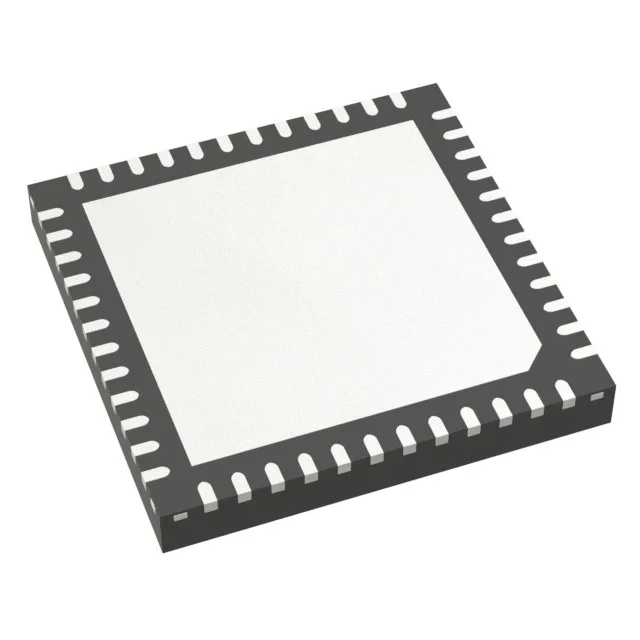
100 MHz Cortex-M4 in a compact 48-UFQFPN
The 48-UFQFPN with exposed pad (7x7 mm) needs a thermal via stitch under the paddle if continuous loads push junction temperature near the ceiling.
What the 100 MHz core and memory mean for your BOM
At 100 MHz the Cortex-M4 delivers roughly 125 DMIPS with DSP single-cycle multiply-accumulate. That is enough headroom to run a real-time control loop (e.g., field-oriented motor control at 20 kHz PWM update rate) while still servicing UART and SPI traffic without a secondary MCU. The 32 KB SRAM is the tight spot for data buffers. A 256-point FFT at 32-bit floats consumes about 2 KB; a 1 KB Ethernet frame buffer would eat 3% of it. If your application queues multiple CAN or UART messages, budget the RAM before committing the BOM. The 10-channel 12-bit ADC and single 12-bit DAC cover analog front-end needs without an external converter for most sensor-conditioning tasks.
The base product number is STM32F410, which shares the same die and peripheral set across the density and package options — useful if you need to scale Flash or pin count later without rewriting firmware.
How it compares to the STM32L151CBU6A
The closest functional cross-shop is the STM32L151CBU6A, an ARM Cortex-M3 at 32 MHz with 37 I/Os and a USB peripheral. The STM32F410C8U6 runs at 100 MHz vs 32 MHz — over 3× the core throughput — and includes DSP instructions and a single-cycle multiplier that the Cortex-M3 lacks. The trade-off is power: the STM32L1 series is optimised for sub-100 µA standby, while the STM32F4 draws more in active mode. If your application needs USB or longer battery life, the is the better fit; if you need the M4's signal-processing headroom, the F4 wins.