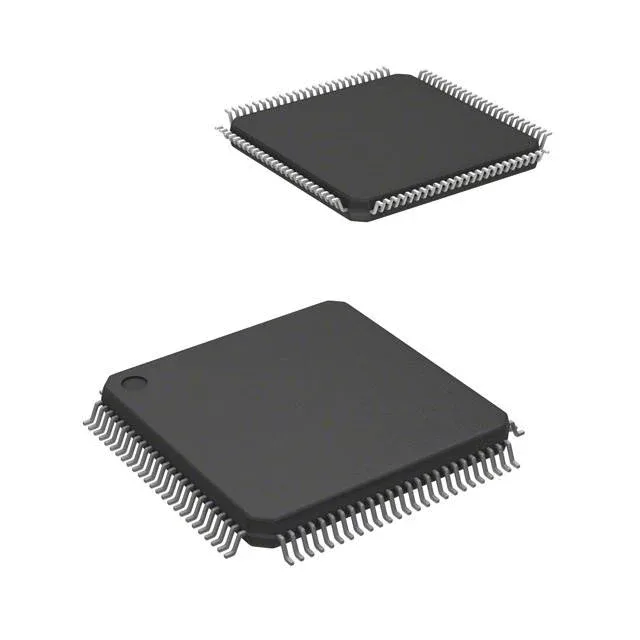
STMicroelectronics STM32F407VGT6TR — Microcontrollers & Processors (MCU / MPU / DSP)

STM32F407VGT6TR STM32F4 MCU, ARM Cortex-M4, 168MHz

MPNSTM32F407VGT6TR
Active

STMicroelectronics STM32F4 series STM32F407VGT6TR, ARM Cortex-M4, 32-bit, 168MHz, 1MB Flash, 192K x 8 RAM, 100-LQFP, -40 to 85°C.

$16.5200Ref. price · indicative, final on quote
Independent supplier — new & surplus stockAuthenticity-screened · ESD-safe packingListing updated Jul 2026

Specifications

STM32F407VGT6TR specifications
ParameterValue
SeriesSTM32F4
MountingSurface Mount
Oscillator typeInternal
Program memory typeFLASH
Voltage - supply (Vcc (Vdd))1.8V ~ 3.6V
Operating temperature-40°C~85°C(TA)
Speed168MHz
PackageTape & Reel (TR); Cut Tape (CT)
RAM size192K x 8
Core size32-Bit Single-Core
PeripheralsBrown-out Detect/Reset, DMA, I²S, LCD, POR, PWM, WDT
ConnectivityCANbus, DCMI, EBI/EMI, Ethernet, I²C, IrDA, LINbus, SPI, UART/USART, USB OTG
Number of i (O)82
Core processorARM® Cortex®-M4
Case100-LQFP
Data convertersA/D 16x12b; D/A 2x12b
Program memory size1MB (1M x 8)

Product details

The STM32F407VGT6TR: This core architecture handles real-time control loops, audio processing, and sensor fusion without an external DSP — the FPU accelerates PID calculations and FFTs in motor-drive and vibration-analysis applications. The 1 MB Flash and 192 KB SRAM provide enough headroom for a full Ethernet TCP/IP stack, a camera frame buffer, and a real-time OS scheduler without external memory.

Peripheral set: Ethernet, CAN, USB OTG, camera interface

The STM32F407VGT6TR integrates an Ethernet MAC (MII/RMII), two CAN 2.0B controllers, USB OTG FS/HS, and a DCMI parallel camera interface. For industrial gateway designs, this means one MCU handles the motor-drive CANopen stack, the Ethernet-to-cloud uplink, and a USB configuration port — no external network controller or PHY-management MCU needed. The 82 general-purpose I/O in the 100-LQFP package give ample headroom for parallel LCD data buses, external memory address lines, and sensor array inputs.

The STM32F4 series has a long roadmap commitment from ST — the 168 MHz Cortex-M4 with 1 MB Flash sits in the volume-sweet-spot tier.

100-LQFP package: footprint and rework considerations

Housed in a 100-LQFP with a 14x14 mm body and 0.5 mm pitch, this package is standard for medium-complexity MCU boards. The exposed pad is not present on LQFP — thermal dissipation relies on the leadframe and board copper. The Tape & Reel variant (TR suffix) is the production-friendly format for automated pick-and-place, while Cut Tape (CT) is available for prototyping and low-volume builds.

Frequently asked questions

What is the difference between STM32F407VGT6 and STM32F407VGT6TR?

The STM32F407VGT6 and STM32F407VGT6TR are electrically and functionally identical — the only difference is the packaging format. The STM32F407VGT6 ships in Tray, while the STM32F407VGT6TR ships in Tape & Reel (TR) for automated assembly. Both are the same base product STM32F407VGT6.

What is the closest pin-compatible alternative to STM32F407VGT6TR in this component family?

Within the STM32F4 series, the STM32F405VGT6 is pin-compatible and shares the same 100-LQFP footprint, but lacks the Ethernet MAC, DCMI camera interface, and the full 192 KB SRAM. The STM32F407VET6 offers the same peripherals but with 512 KB Flash instead of 1 MB — a density trade-off for cost-sensitive builds.