168 MHz Cortex-M4 with FPU — the connectivity workhorse
This is the mid-density, high-connectivity member of the STM32F4 line: it integrates an Ethernet MAC, two CAN 2.0B interfaces, a USB OTG controller, and a DCMI camera interface alongside the usual complement of SPI, I2C, UART, and I2S peripherals. The part is aimed at industrial control nodes, motor drives, PLCs, and IoT gateways where a real-time control loop shares the core with a TCP/IP stack and a fieldbus protocol. The 168 MHz core with FPU handles single-cycle MAC operations and trigonometric math without a software library, which matters for sensor fusion and motor FOC algorithms. The 192 KB SRAM is split across 128 KB in the main block and 64 KB in the tightly coupled CCM data RAM — the CCM runs at core speed with zero wait states, ideal for time-critical variables and interrupt stacks.
512 KB Flash and 192 KB SRAM — staging the firmware and data
With 512 KB of Flash, the firmware budget can accommodate a full RTOS (FreeRTOS or ThreadX), a LwIP TCP/IP stack, a CANopen or EtherCAT slave stack, and still leave room for an OTA update image buffer. The 192 KB SRAM means most designs can skip an external SRAM or SDRAM — two QVGA frame buffers (320x240 at 16-bit) fit within 150 KB, leaving 42 KB for the heap and stack. The CCM RAM (64 KB) is not accessible by the DMA, so DMA buffers must be placed in the main SRAM block.
Ethernet, CAN, USB OTG — the peripheral set that defines the part
The STM32F407VET6TR includes an Ethernet MAC (MII/RMII) with a dedicated DMA controller, two CAN 2.0B interfaces, and a USB OTG FS/HS controller with on-chip PHY. This peripheral set is the main parametric difference from the lower-cost STM32F405 series, which omits the Ethernet MAC. For a design that needs both a wired network connection and a CAN bus — an industrial gateway, a battery-management system controller, or a building-automation head-end — this MCU covers both without an external Ethernet controller chip. The DCMI parallel camera interface also makes it a candidate for machine-vision front ends that do not need a dedicated ISP.
It is not rated for 105°C extended industrial or 125°C automotive under-hood applications — for those, look at the STM32F407VE's automotive-grade sibling (if available) or the STM32F4 with a '7' suffix.
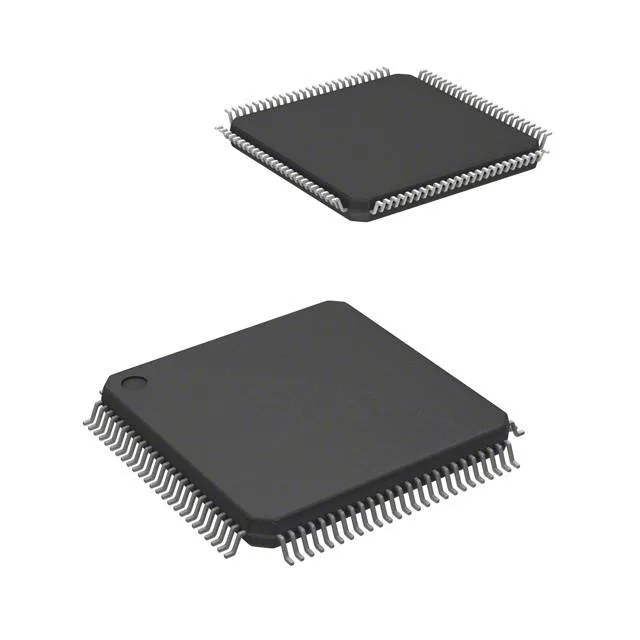
100-LQFP (14x14) — a reworkable, standard-density footprint
The 14x14 mm body fits in compact enclosures. The CT (Cut Tape) variant is also available for smaller builds.
STMicroelectronics has not issued a PCN or EOL notice for the STM32F407VE base number as of the latest records. The ROHS3 compliance covers the current EU directive exemptions.