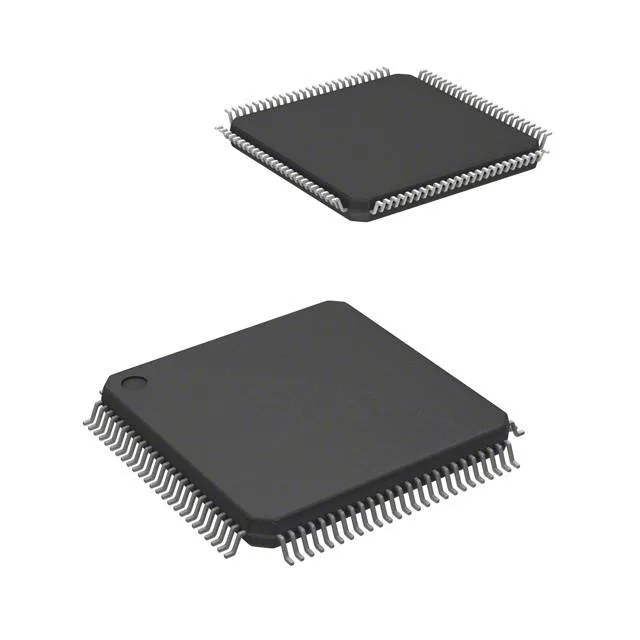
What the 168 MHz Cortex-M4 core buys you on this STM32F405VGT6
The core runs at 168 MHz. The 1 MB Flash (1M x 8) and 192 KB SRAM (192K x 8) provide memory for a real-time OS, a TCP/IP stack, and a display buffer. With 82 I/O brought out to a 100-pin LQFP (100-LQFP, 14x14 mm body), this part fits on a four-layer board without blind vias. The peripheral set includes CANbus, EBI/EMI for external SRAM or NOR Flash, multiple I²C and SPI buses, and USB OTG — enough connectivity to serve as the main controller in an industrial PLC, a motor drive, or a human-machine interface panel. D/A 2x12b) are integrated on-chip, which saves the cost of an external analog front-end for multi-sensor acquisition or closed-loop analog outputs.
The 168 MHz Cortex-M4 FPU enables single-cycle MAC operations. The ART Accelerator hides most flash wait-state penalties for sequential code.
1 MB Flash and 192 KB SRAM — sizing the firmware and data budget
1 MB of Flash (1M x 8) is the high-density tier in the STM32F4 family. It fits a full FreeRTOS or ThreadX kernel, a LwIP TCP/IP stack, a USB device stack, and a graphical library like LVGL with room left for application code. The 192 KB SRAM (192K x 8) is split across multiple blocks — 64 KB of CCM (core-coupled memory) runs at full 168 MHz without bus contention, ideal for critical interrupt handlers or time-domain audio buffers. The remaining 128 KB is on the main AHB bus for DMA and peripheral access. If the application needs more than 192 KB of RAM, the EBI/EMI interface can drive external SRAM, PSRAM, or NOR Flash up to 32-bit wide. That bus runs at up to 60 MHz, so it adds latency but keeps the memory map flat.
For production planning, that means no forced redesign or end-of-life inventory hoarding.
Sourcing this STM32F405VGT6 for your BOM
For a production BOM line, the active lifecycle and wide distributor reach mean you can dual-source through multiple channels without redesign risk.