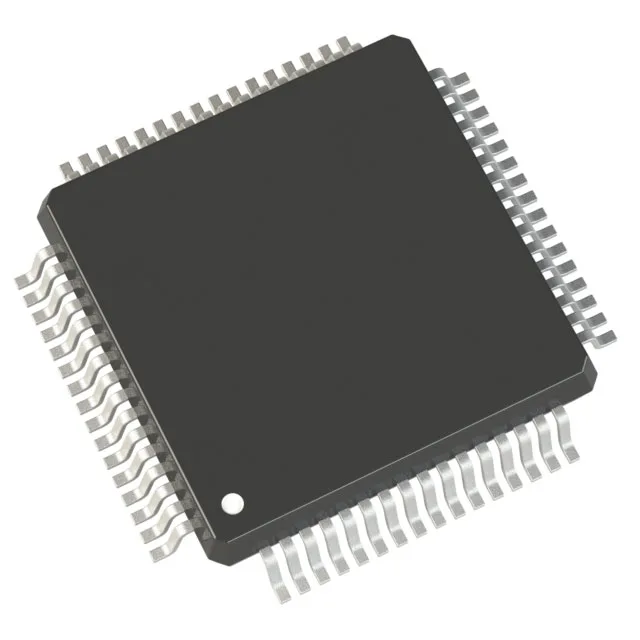
The Cortex-M4's FPU handles single-precision float natively — no software emulation, no cycle penalty. If your firmware does any trig, matrix math, or sensor calibration, that FPU saves you both code space and execution time versus a Cortex-M3 at the same clock.
Memory sizing and firmware strategy
256 KB Flash and 64 KB SRAM is the sweet spot for a single-protocol stack (USB OTG + one UART) plus a modest application layer. The Flash is large enough to hold a bootloader and two application images if you're doing OTA updates with external storage. The 64 KB SRAM handles double-buffered USB and a 1 KB DMA descriptor table without squeezing the stack. No EEPROM on die — use the Flash with wear-leveling or an external I²C EEPROM for calibration constants.
Connectivity and I/O — what's on the pins
The IrDA and LINbus support means this MCU can sit on an automotive LIN node or an infrared data link without an external transceiver for the protocol layer. Brown-out detect and POR are integrated, so a simple RC reset is sufficient for most designs.
Temperature range and supply — where it lives
At 1.8 V the Flash still reads at full speed, so you can drop the core voltage for power savings in battery gear without a performance hit.
The exposed pad (if present on this variant) should be stitched to ground with at least four vias for thermal relief if the MCU is driving more than 50 mA total I/O.
The base product number STM32F401 covers a range of Flash and SRAM options in the same package, so if you later need more memory, a pin-compatible upgrade exists within the family.