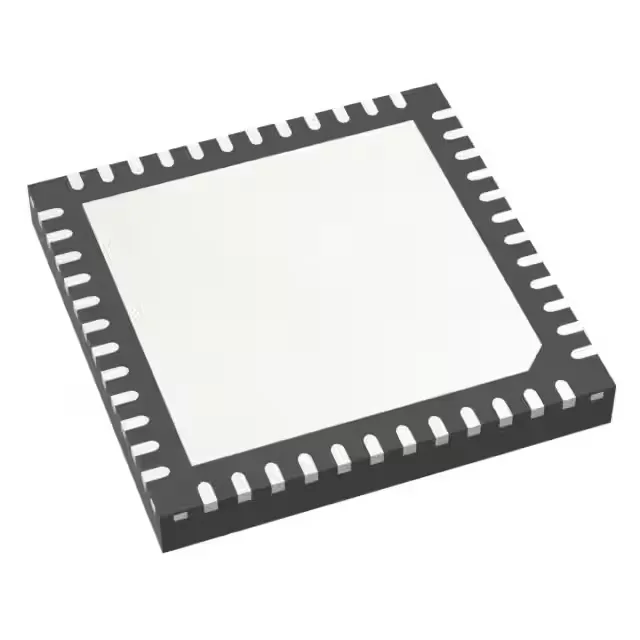
The 48-pin UFQFN package with exposed pad keeps the board footprint small while the pad helps pull heat out when the core is running flat out. The Cortex-M4 with FPU runs at 84 MHz, a deliberate cost- and power-optimization point.
Flash, RAM, and the firmware budget
The Flash holds the application code and constant data; the RAM handles stack, heap, and DMA buffers. If you're planning a full GUI framebuffer or a large audio sample buffer, that 64 KB RAM ceiling will be the tighter constraint — plan your memory map early. Flash endurance is rated for the STM32F4 family standard: 10,000 erase/write cycles per sector, with 10-year data retention at 85°C. The 128 KB is organized into sectors of varying size — check the reference manual for the exact sector map if you're implementing a bootloader or OTA update scheme.
Peripherals and connectivity — what's on the bus
The peripheral set includes USB OTG (full-speed, with on-chip PHY), three USARTs (supporting IrDA and LIN), up to three SPIs (one with I²S multiplexed), two I²Cs, and an SDIO interface for external storage. That's enough to wire up a sensor cluster over I²C, log data to an SD card, and talk to a host over USB or UART simultaneously. The 10-channel 12-bit ADC runs at up to 2.4 MSPS in the F401 family, though the exact throughput depends on the number of channels sampled and the clock divider. It's a successive-approximation converter with injected and regular group conversion modes — sufficient for reading potentiometers, current-sense resistors, or analog sensor outputs without an external ADC. 36 general-purpose I/Os are brought out on the 48-pin package. That's enough for a 16-bit parallel LCD data bus plus control lines, or a handful of encoder inputs and PWM outputs, but you'll need to check the pin-mux conflicts if your design uses many of the alternate functions simultaneously.
Package, thermal, and layout notes
The datasheet recommends a 4x4 via pattern with 0.3 mm drill holes — skip those vias and the junction temperature will climb quickly at high core load or when driving multiple outputs. The pad is electrically connected to VSS, so it's safe to tie directly to the ground pour. The on-chip POR and brown-out detect (BOR) handle the reset sequencing across that range, but if you're running near the 1.7 V floor, pay attention to the BOR threshold hysteresis in the datasheet to avoid spurious resets during supply ripple.
There is no announced EOL or last-time-buy window for this base part number as of the latest available data. This means it remains suitable for new design-ins and production ramps without an imminent end-of-life risk. For production volumes or long-term supply agreements, the distributor network can provide factory lead-time visibility.