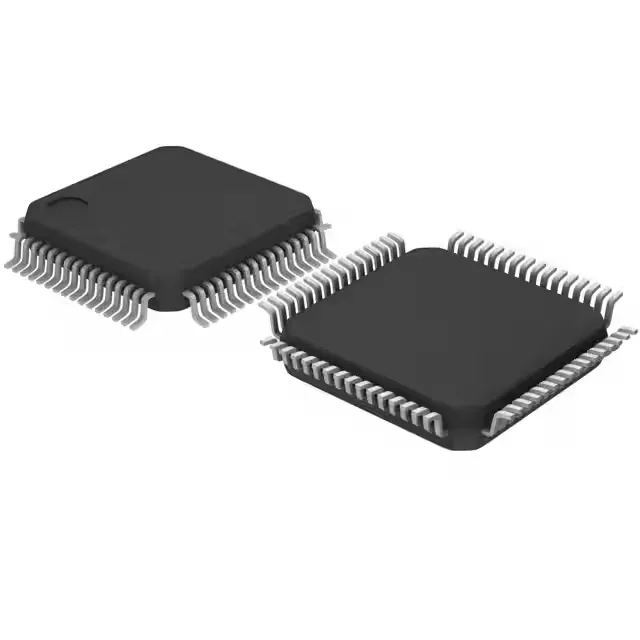
Its distinguishing feature is the set of three 16-bit sigma-delta ADCs alongside a 12-bit SAR ADC and three 12-bit DACs — a mixed-signal front end that eliminates external converter ICs in sensor-heavy designs like motor-feedback, weigh-scale, or multi-channel data acquisition. Program memory is 256 KB of Flash, with 32 KB SRAM for data buffers and stack.
Sigma-delta ADCs — the real differentiator
Three 16-bit sigma-delta ADCs on a Cortex-M4 part at this price tier is unusual. They give you simultaneous, oversampling conversion with programmable gain and digital filtering on-chip — useful for reading load cells, current shunts, or thermocouple bridges without a separate AFE. The 12-bit SAR ADC handles the faster scan tasks (e.g., phase currents in a motor drive), while the sigma-delta channels take care of the precision measurements. The three 12-bit DACs can output analog setpoints or bias voltages directly, reducing the analog component count on the board.
For a BOM that needs to stay in production for several years, the STM32F373RCT6 does not carry the obsolescence risk that older STM32F1 or F2 parts sometimes do. No official successor has been named because none is needed — the part is still being manufactured and supported.
Supply voltage and temperature — industrial fit
If your application needs 105 °C or 125 °C, you would need to look at the extended-temperature variants in the STM32F3 family.
On the communication side, the STM32F373RCT6 includes CANbus, I²C, SPI, UART/USART, USB, IrDA, and LINbus — enough for industrial fieldbus gateways, sensor hubs, or motor-drive comms. The DMA controller offloads the Cortex-M4 core for high-throughput data movement, and the PWM timers are suitable for three-phase motor control or digital power conversion.