72 MHz Cortex-M4F with FPU — the control-loop workhorse
The part is built for sensor-fusion and motor-control applications where the FPU accelerates PID loops and the 12-bit ADC bank (four converters) captures multiple analog channels without external muxing.
1.65V to 1.95V supply — single-cell LiFePO4 or 1.8V rail only
The supply range of 1.65V to 1.95V is narrower and lower than the typical 2.0V–3.6V found on most STM32F3 variants. This part is designed for a dedicated 1.8V rail — common in battery-backed or low-voltage sensor nodes — and will not tolerate a 3.3V supply. If your existing BOM runs on 3.3V, this is the wrong drop-in; look at the STM32F303 or STM32F378 series instead. The internal oscillator and POR circuitry are optimised for this voltage window, so an external regulator with tight tolerance is recommended.
The four 12-bit ADCs and two 12-bit DACs give it enough analog front-end capability to handle current sensing and analogue output in a single chip. The 86 I/O count in a 100-LQFP leaves most pins available after allocating the usual power and oscillator connections.
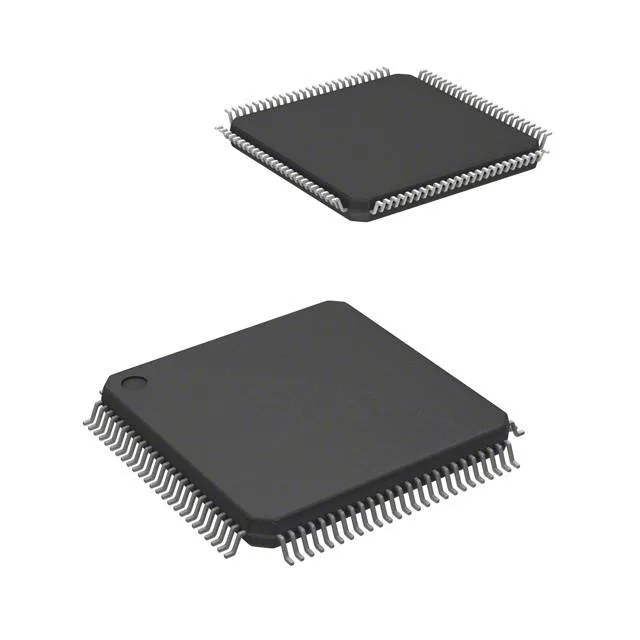
The 100-LQFP package is surface-mount and standard for reflow assembly;.
For production planning, the ROHS3 compliance is confirmed.