72 MHz Cortex-M4 with FPU — what it means for a control loop
That FPU is the key differentiator versus the Cortex-M3 siblings in the STM32F3 family: it handles a 32-bit float multiply-accumulate in a single cycle, so sensor fusion or PID loops with fractional coefficients run without a software emulation penalty. The 64 KB of Flash and 12 KB of SRAM are sized for a single control algorithm plus a modest communications stack — think a field-oriented motor drive, a digital power supply loop, or an industrial I/O node that needs CANopen or Modbus on the side.
Analog integration: 21 ADC channels and 3 DACs
The part packs 21 analog-to-digital converter channels (12-bit resolution) and three 12-bit digital-to-analog converters. For a motor-control design that samples three phase currents plus a DC-link voltage and a temperature sensor, the ADC channel count means you can keep the signal chain single-chip without an external mux. The three DACs can generate reference voltages, offset trim, or analog setpoints — useful for setting comparator thresholds or driving an analog isolator front-end.
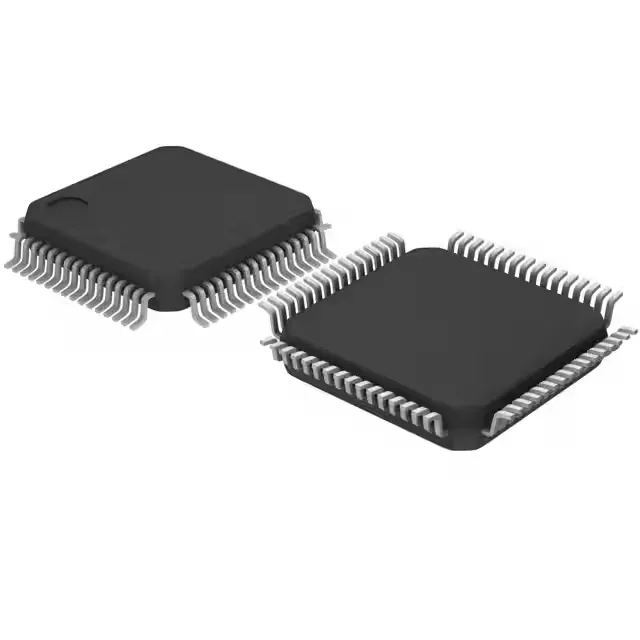
For dual-sourcing or a pin-compatible alternative within the same STM32F334 value line, the STM32F334C8T6 shares the same core, memory, and peripheral set but in a 48-pin LQFP package — the 64-pin R8T6 variant offers 51 I/O versus the 48-pin part's reduced pin count, so a board designed for the 64-LQFP footprint cannot drop in the 48-pin package without a layout change.