72 MHz Cortex-M4 with FPU — what the core speed buys you
That FPU handles real-time control loops — motor-current regulation, digital power-supply compensation, sensor fusion — without the software overhead of a software-emulated float. The 72 MHz core, combined with the DMA and PWM peripherals, keeps the CPU free for higher-level tasks while the hardware handles time-critical I/O.
Memory sizing: 32 KB Flash, 12 KB SRAM — what fits
32 KB of Flash and 12 KB of SRAM target compact firmware: a single motor-control FOC algorithm, a CANopen stack with a few PDOs, or a sensor-hub aggregator. The 12 KB SRAM is enough for a modest RTOS heap and a couple of ping-pong buffers for the ADC or DAC. If your application needs a full TCP/IP stack or a large data logger, you will outgrow this part — step up to the STM32F334K8 (64 KB Flash) or the STM32F334R8 (64 KB Flash, 48-pin).
The 105°C ceiling means it can sit next to a power stage or in a sealed outdoor enclosure without needing a separate high-temp variant. If your design lives in a climate-controlled lab, the commercial-grade STM32F334K6T6 (0°C to 70°C) is a cost-down option — but for production BOMs that see a factory floor or a vehicle, the T7 grade is the safer call.
Analog front-end: 9-channel 12-bit ADC and three 12-bit DACs
Nine 12-bit ADC channels and three 12-bit DACs are integrated on-chip, reducing external analog components. The ADC can sample multiple current-sense resistors and a voltage feedback simultaneously; the DACs can generate reference voltages or analog setpoints for external comparators. For a three-phase motor drive, you get one ADC channel per phase plus a DC-link voltage sense, with DACs for current-limit thresholds or offset nulling — all without external op-amps or DACs.
Connectivity: CAN, LIN, I²C, SPI, UART — what each bus is for
CAN and LIN interfaces make this MCU a natural fit for automotive body-control modules, sensor nodes, or industrial fieldbus gateways. The I²C and SPI ports handle local peripherals — external EEPROM, temperature sensors, display controllers. UART/USART plus IrDA support legacy serial links and infrared communication. With 25 I/O pins in a 32-LQFP package, you have enough headroom for a few external interrupts and a parallel LCD data bus if needed.
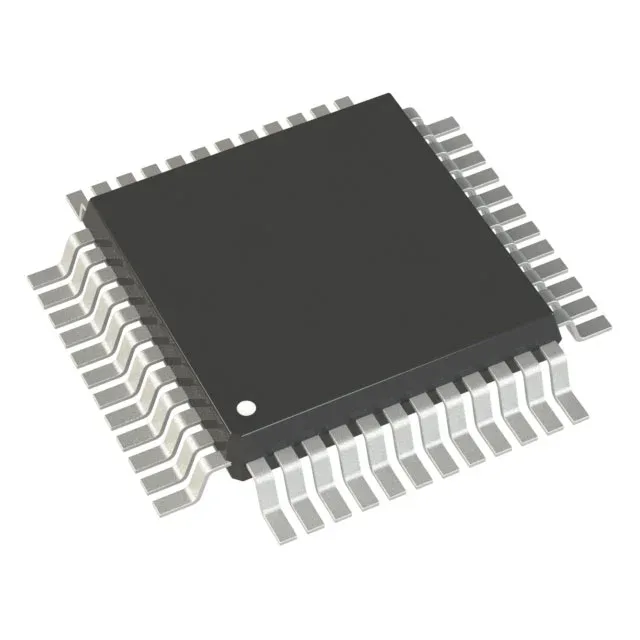
Package and footprint: 32-LQFP (7x7 mm)
The 25 I/O pins are distributed around the four sides, leaving room for a ground plane under the package.