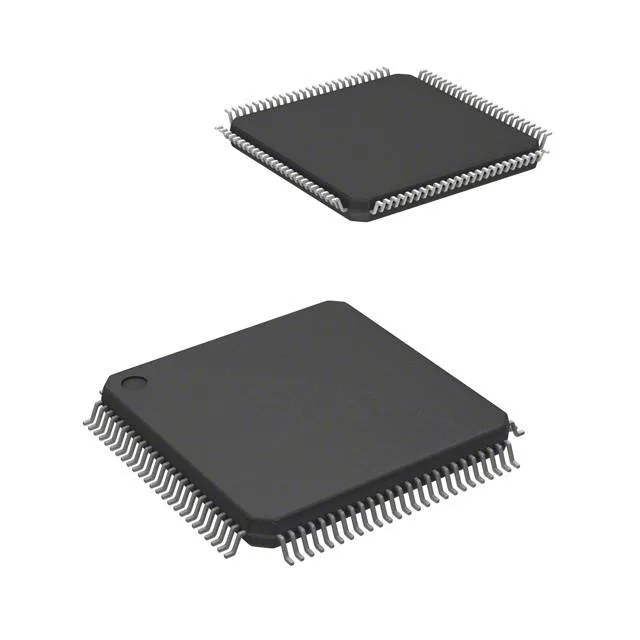
STMicroelectronics STM32F303VBT6 — Microcontrollers & Processors (MCU / MPU / DSP)

STM32F303VBT6 ARM Cortex-M4 MCU, 72MHz, 128KB Flash

MPNSTM32F303VBT6
Active

STMicroelectronics STM32F3 series, STM32F303VBT6, ARM Cortex-M4 32-Bit Single-Core MCU, 72MHz, 128KB Flash, 32K x 8 RAM, DMA, I²S, POR, PWM, WDT, CANbus, I²C, IrDA, LINbus, SPI, UART/USART, USB, 87 I/O, 100-LQFP, -40°C to 85°C.

$8.4400Ref. price · indicative, final on quote
Packaging100-LQFP
RoHSROHS3 Compliant
SeriesSTM32F3
Independent supplier — new & surplus stockAuthenticity-screened · ESD-safe packingListing updated Aug 2026

Specifications

STM32F303VBT6 specifications
ParameterValue
SeriesSTM32F3
MountingSurface Mount
Oscillator typeInternal
Program memory typeFLASH
Voltage - supply (Vcc (Vdd))2V ~ 3.6V
Operating temperature-40°C ~ 85°C (TA)
Speed72MHz
PackageTray
RAM size32K x 8
Core size32-Bit Single-Core
PeripheralsDMA, I²S, POR, PWM, WDT
ConnectivityCANbus, I²C, IrDA, LINbus, SPI, UART/USART, USB
Number of i (O)87
Core processorARM® Cortex®-M4
Case100-LQFP
Data convertersA/D 39x12b; D/A 2x12b
Program memory size128KB (128K x 8)

Product details

What the 72 MHz core and 128 KB Flash mean for the BOM

At 72 MHz the Cortex-M4 can execute a single-cycle MAC or a hardware divide in one clock, which matters when you're running a field-oriented control (FOC) loop for a BLDC motor or a digital filter at tens of kilohertz. The 128 KB Flash is enough for a moderate firmware stack — a FreeRTOS kernel, a CANopen stack, and two or three control loops — but if you need over-the-air update staging or a larger application, you'll be looking at the STM32F303VCT6 or the STM32F303RET6 with 256 KB and 512 KB respectively. The 32K x 8 SRAM leaves room for a few large buffers; budget carefully if you're doing high-rate data logging or double-buffered graphics.

Analog integration: 39-channel ADC and dual DAC

The 39-channel 12-bit ADC covers a lot of analog inputs without an external multiplexer — think three-phase current sensing plus voltage and temperature monitoring on a single motor drive board. The two 12-bit DACs can generate analog setpoints or reference voltages, saving an external DAC or a PWM-filter stage. This analog density is the STM32F3 series' differentiator versus the STM32F1 or STM32L1 lines, which offer fewer ADC channels and no on-chip DAC in the same pin count.

Industrial temperature grade and connectivity

The connectivity set includes CANbus, USB, multiple SPI, I²C, and UART interfaces, plus IrDA and LINbus, covering most fieldbus and debug/programming needs without external transceivers on the MCU side. The 87 I/O pins in the 100-LQFP package give you headroom for parallel displays, memory buses, or large sensor arrays.

ROHS3 compliant. This is a mainstream STM32F3 part, widely stocked across the independent distribution channel.

Frequently asked questions

What is the difference between STM32F303VBT6 and STM32F303VCT6?

The STM32F303VCT6 is a higher-density variant in the same STM32F3 family. If your firmware image and data buffers fit within 128 KB / 32K x 8, the VBT6 is the cost-optimized choice.

When sourcing STM32F303VBT6, what's the closest functional second-source?

The STM32L151CBU6A is a lower-power ARM Cortex-M3 alternative from ST's STM32L1 series, but it is not a pin-compatible or direct second source. It runs at 32 MHz, has 37 I/O, and lacks the FPU and the 39-channel ADC of the F303. For a true functional equivalent within the same family, consider the STM32F303VCT6 (256 KB Flash) if more memory is needed, or the STM32F303RBT6 (64-pin) if reducing pin count. No exact second-source exists outside ST's own portfolio.