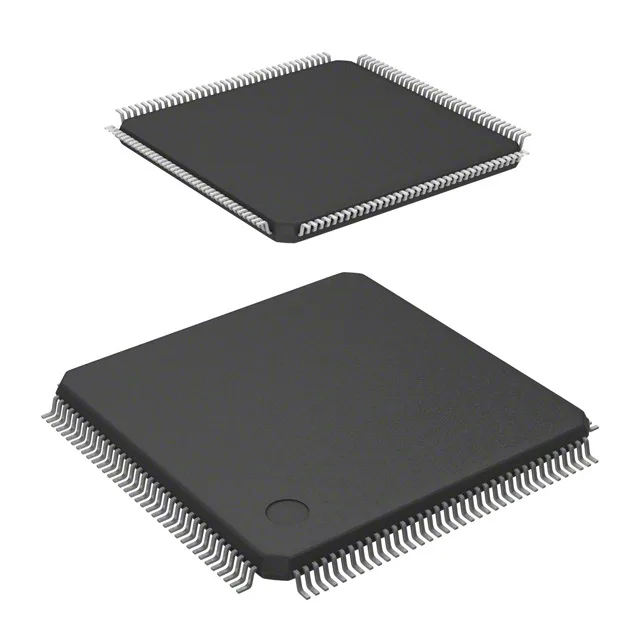
ARM Cortex-M4 at 72 MHz with FPU — what it means for control loops
Its 72 MHz core includes a single-precision floating-point unit (FPU) that accelerates motor-control FOC loops, digital power-supply compensators, and sensor-fusion math without a separate DSP or external FPU.
115 I/Os and 144-LQFP — package-driven pin count
With 115 general-purpose I/Os mapped to a 144-LQFP (20x20 mm) package, this part suits designs that need parallel display interfaces, multiple encoder inputs, or a bank of relay drivers alongside standard serial peripherals. The 144-LQFP is hand-solderable in a rework station and does not require X-ray inspection like a BGA — a practical advantage for low-volume production or field repair.
Analog front end: 18x12-bit ADC and 1x12-bit DAC
The on-chip data converters include eighteen 12-bit ADC channels and one 12-bit DAC. For a motor-drive or power-converter design, that means voltage and current sensing on all three phases plus DC-link and temperature channels without external multiplexers. The single DAC can serve as a reference for an external comparator or as a programmable setpoint for an analog control loop. The 12-bit resolution is adequate for 0.1% sensing accuracy with proper scaling — not a 16-bit precision instrumentation part, but the right fit for embedded control.
Connectivity and peripherals for industrial bus integration
On the communication side, the STM32F302ZDT6 carries CANbus, I²C, SPI, UART/USART, USB, IrDA, and LINbus interfaces, plus I²S for audio or serial data streaming. The DMA controller offloads the CPU for high-rate peripheral transfers — useful when servicing multiple ADC conversions or UART streams simultaneously. The internal oscillator and POR/WDT reduce external BOM count for cost-sensitive industrial nodes.