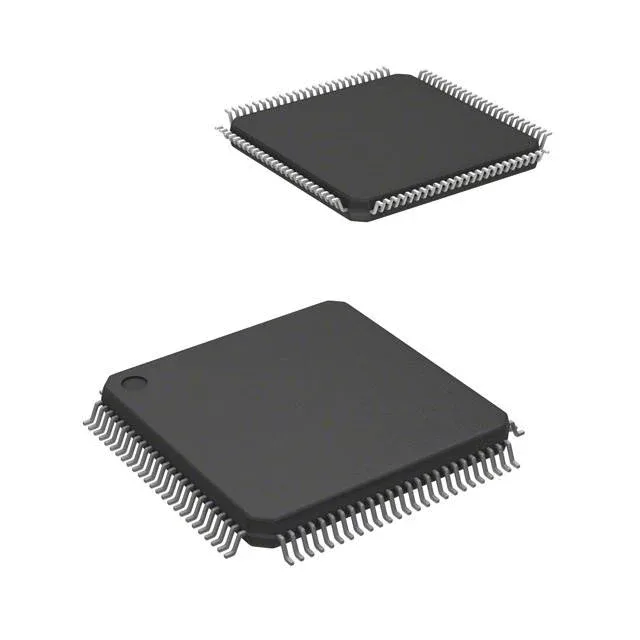
The STM32F302VET6TR is a 32-bit ARM Cortex-M4 MCU from STMicroelectronics, clocked at 72 MHz with 512 KB of Flash program memory and 64 KB of RAM. It is built for real-time control applications — motor drives, digital power conversion, and industrial automation — where the DSP extensions and single-cycle MAC accelerate field-oriented control loops and sensor fusion without an external DSP. The 17-channel 12-bit ADC and single 12-bit DAC handle multi-phase current sensing and a single analog output, reducing external signal-chain components. Connectivity includes CAN, I2C, SPI, UART/USART, and USB, covering CANopen fieldbus, sensor buses, and debug/programming links on one chip. Operating from 2 V to 3.6 V and rated for -40°C to 85°C, this part fits industrial enclosures and outdoor telecom cabinets without active cooling. The 100-LQFP package (14x14 mm) provides 86 I/O lines for parallel sensor arrays or display interfaces.
Lifecycle reality — EOL hot, sourcing through independent channels
The STM32F302VET6TR is flagged EOL hot (end-of-life, last-time-buy phase). Production is winding down; the manufacturer's last-time-buy window may have closed or is closing. This part is not available through standard authorized-distributor channels in volume. The base product number is STM32F302; pin-compatible density variants with different Flash sizes may still be active. Confirm the exact Flash/RAM fit before substituting.
What the 72 MHz and 512 KB Flash mean for your design
At 72 MHz, the Cortex-M4 delivers DSP extensions for motor control and CAN communication. The 512 KB Flash holds a motor-control stack plus bootloader; 64 KB RAM leaves headroom for data buffers.
Package and mounting — 100-LQFP, 14x14 mm
The 100-LQFP package (14x14 mm body) is surface-mount and reflow-solderable. The 86 I/O lines fan out to peripheral interfaces and GPIO.