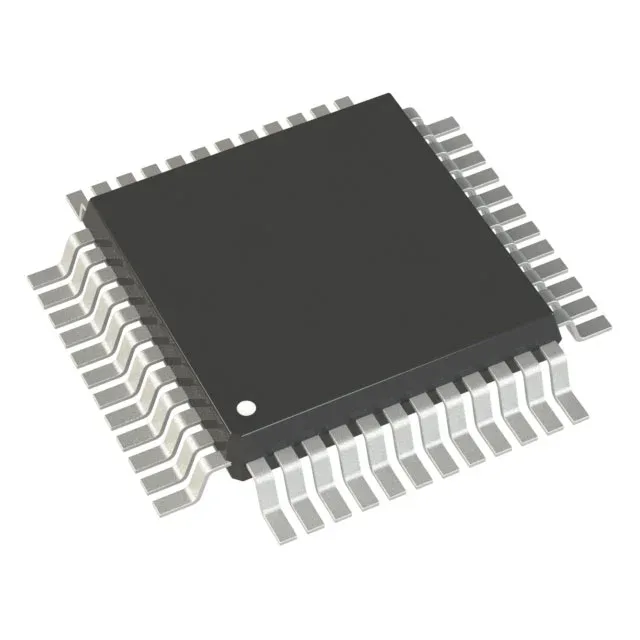
The STM32F301K8T7: The Flash is enough for moderate mixed-signal control firmware — think field-oriented motor control, digital power conversion, or sensor fusion algorithms — but tight if you plan to include a full RTOS with extensive logging or a GUI stack. The 16 KB SRAM handles typical control-loop data structures and a few moderate buffers; if your application needs large frame buffers or extensive trace data, step up to the 32 KB SRAM variants in the same family.
8-channel 12-bit ADC and 1-channel 12-bit DAC — analog front-end integration
The integrated 12-bit ADC samples up to 8 external channels, and the 12-bit DAC provides a single analog output — enough for simultaneous current/voltage sensing and a setpoint or bias output in a motor drive or power supply. The ADC's 12-bit resolution is adequate for most industrial sensing; if you need higher precision (e.g., 16-bit) you'd add an external SAR ADC.
25 I/O in a 32-LQFP — footprint and routing
The 32-LQFP (7x7 mm) package gives you 25 general-purpose I/O — enough for a modest set of sensors, actuators, and communication peripherals. The 0.8 mm pitch is hand-solderable and inspectable, and the 7x7 mm footprint fits tight PCBs without needing blind vias. If you need more I/O, the 48-pin or 64-pin LQFP variants in the STM32F301 family are pin-compatible on the inner pins.
There is no last-time-buy clock to watch, and the manufacturer continues to support the part with datasheets, errata, and application notes. For a new BOM, this is the safest lifecycle status you can have.