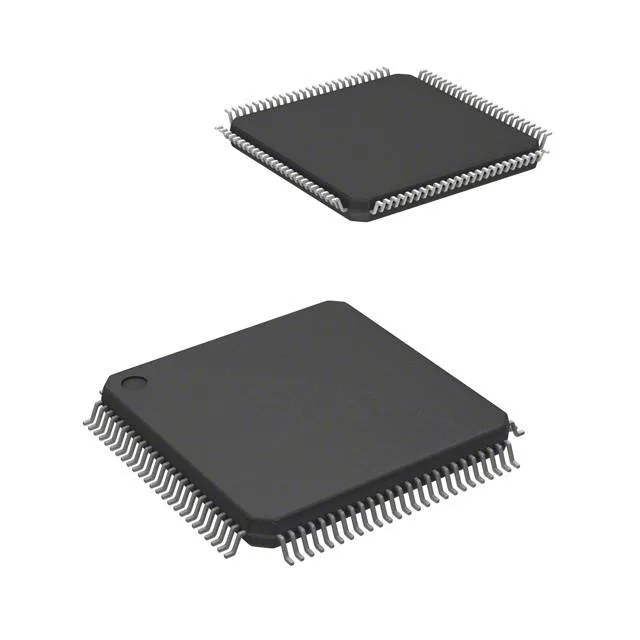
Connectivity-optimized STM32F1 with Ethernet MAC
What sets this part apart from other STM32F1 members is its integrated Ethernet MAC peripheral alongside CAN 2.0B, USB OTG, and multiple serial interfaces — making it the connectivity hub of the family.
At 72 MHz the ARM Cortex-M3 core delivers 1.25 DMIPS/MHz, enough to run a lightweight TCP/IP stack (lwIP) alongside a CANopen master and a USB device stack without resorting to external DMA offload for most frames. The 64 KB SRAM is the practical constraint: Ethernet jumbo frames and multiple CAN message objects consume buffer space quickly, so budget the memory map before committing the protocol mix. The flash wait state needs setting to 1 when the system clock exceeds 24 MHz — the bootloader default of 0 wait states will hard-fault on the first branch above that speed.
Peripheral set: Ethernet, CAN, USB OTG, and 12-bit ADC/DAC
The STM32F107VCT7 includes a 10/100 Ethernet MAC with dedicated DMA and an internal PHY interface (MII/RMII), a pair of CAN 2.0B controllers, and a USB OTG full-speed peripheral. For analog interfacing there are 16 multiplexed 12-bit ADC channels and two 12-bit DAC outputs. The peripheral DMA engine handles data transfers without core intervention, which is critical for maintaining Ethernet throughput at 72 MHz. On-chip oscillators eliminate the need for external clock sources in many designs, though an external crystal improves Ethernet timing accuracy.
The 80 I/O lines include 5 V-tolerant inputs on most pins, simplifying level translation when interfacing to legacy 5 V peripherals.