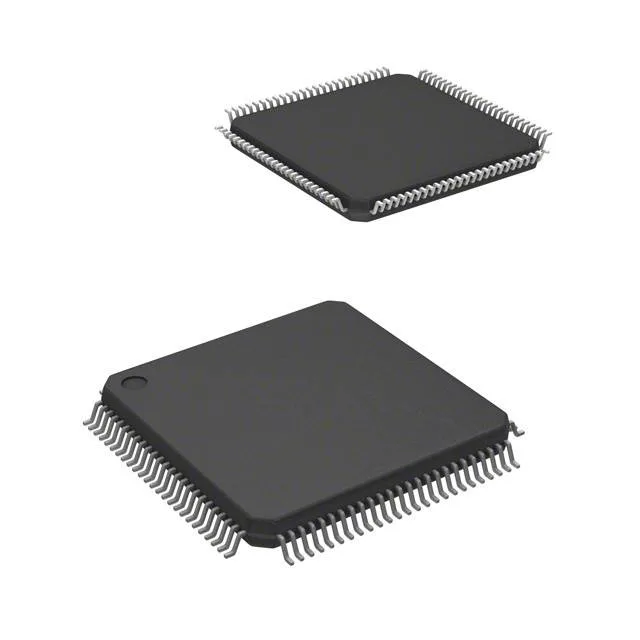
72 MHz ARM Cortex-M3 with Ethernet — the connectivity workhorse
What sets this part apart from the rest of the STM32F1 family is its integrated Ethernet MAC, CAN 2.0B, and USB OTG FS — three wired-connectivity blocks on a single die that make it a natural fit for industrial gateways, PLCs, building-automation controllers, and telematics units that need to bridge fieldbus traffic to an IP network. The 100-LQFP package (14x14 mm, 0.5 mm pitch) gives you 80 GPIOs to work with, plus two 12-bit DACs and a 16-channel 12-bit ADC for analog interfacing.
Ethernet MAC on a 72 MHz Cortex-M3 — what the peripheral set means for your architecture
The integrated Ethernet MAC with dedicated DMA and descriptor-based buffer management offloads frame handling from the CPU core. At 72 MHz the Cortex-M3 has enough headroom to run a lightweight TCP/IP stack (lwIP or similar) while still handling application logic, though you'll want to budget MII/RMII pins and an external PHY chip on the board — the MAC is the controller, not the transceiver. The CAN and USB OTG peripherals share the same DMA controller, so a typical design uses one channel for Ethernet Rx, another for CAN Tx, and a third for USB bulk transfers without starving the core. The 64 KB SRAM is adequate for two or three packet buffers at 1518-byte MTU, but if your application queues many simultaneous connections, budget external SRAM or move to the STM32F2/F4 family.
ST continues to manufacture the STM32F1 Connectivity Line alongside the newer STM32F2 and STM32F4 series, so this part remains a valid choice for production designs that don't need the higher clock speeds or larger SRAM of the later families. No functional difference, no code change needed when switching between the two packing options.
100-LQFP rework — will it survive the hot air?
The exposed pad is on the bottom but it's a standard LQFP — no hidden thermal ball, no underfill required. A hot-air station set to 340°C with a fine nozzle lifts the part cleanly; just wick the pads flat and flux before placing the replacement.