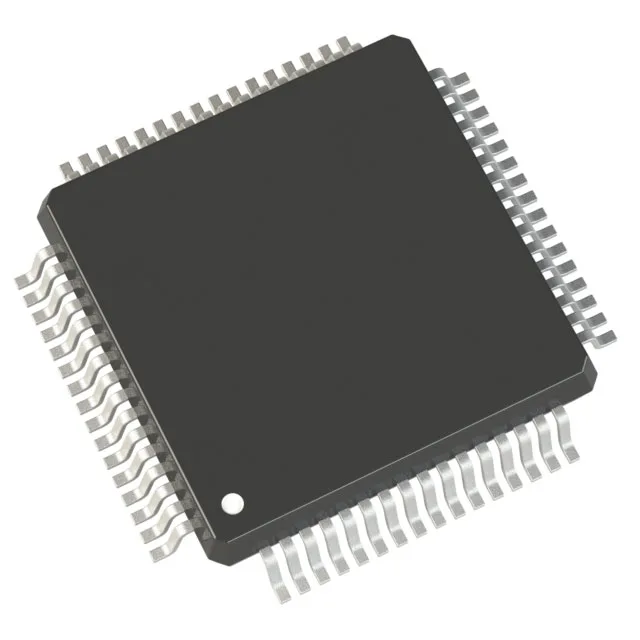
What this STM32F105RCT7 brings to the BOM
It integrates a USB OTG full-speed interface and a CANbus controller on the same die, which cuts the external transceiver count for designs that need both a device-side USB port and a CAN fieldbus link — think telematics gateways, industrial fieldbus adapters, or battery-management modules that talk to both a host PC and a vehicle CAN network. The 51 general-purpose I/Os, two 12-bit DACs, and a 16-channel 12-bit ADC give it enough analog front-end for sensor conditioning without an external ADC.
The 72 MHz core speed is the STM32F1 family's ceiling. At this frequency the flash needs one wait state inserted for zero-wait access, so the effective throughput is about 1.25 DMIPS/MHz — roughly 90 DMIPS total. That is enough to run a real-time control loop (e.g., a field-oriented motor control at 10 kHz update rate) while the USB OTG stack handles a bulk transfer in the background. If your application only needs 48 MHz, the PLL can divide down and you save a wait state, but the 72 MHz part gives headroom for firmware growth without a silicon change.
The 256 KB Flash is organised as 256 K x 8 bits. For a typical USB + CAN gateway, the combined stack (USB device class driver, CANopen or J1939 stack, and a lightweight RTOS) fits in about 100–120 KB, leaving room for a bootloader and OTA staging area. The 64 KB SRAM is enough for two 1 KB CAN message buffers, a 4 KB USB endpoint buffer, and a few hundred bytes of RTOS task stacks. If your application needs larger frame buffers or a TCP/IP stack, the 64 KB SRAM will be the tighter resource — plan to use the DMA controller to move data between peripherals and memory without CPU stalls.
USB OTG and CANbus — dual-interface connectivity
The STM32F105RCT7 includes a USB OTG full-speed (12 Mbps) controller and a CAN 2.0B active controller. Having both on-chip means a single MCU can act as a USB device (e.g., virtual COM port for diagnostics) while simultaneously managing a CAN bus for sensor/actuator communication. The CAN controller supports 32 mailboxes, which is generous for a gateway that must buffer messages from multiple CAN nodes. The USB OTG peripheral can also operate in host mode, so the MCU can talk to a USB flash drive or a Bluetooth dongle without an external host processor.
Package and footprint — 64-LQFP (10x10 mm)
The part is surface-mount only, so it goes through reflow.
If you are planning a multi-year production run, the STM32F1 family has been in the market for over a decade, so the supply chain is mature — but always check for PCN notifications if your design is in a regulated industry.