It includes a USB OTG peripheral that lets the device act as either a USB host or device without an external controller — a feature that sets it apart from many STM32F103 variants.
The 128 KB of Flash (organized as 128K x 8) and 64 KB of SRAM (64K x 8) define the firmware and data budget. For a typical real-time control stack with USB and CAN protocol handling, the Flash fills faster than you might expect — a full USB OTG stack plus a CANopen node can consume 40–60 KB, leaving room for application code but not a heavy GUI or file system. The 64 KB RAM is generous for an MCU in this tier; it supports double-buffered USB transfers and a moderate-size RTOS heap without external memory.
Peripherals and connectivity — CAN, USB OTG, and the usual serial bus set
The USB OTG is the headline differentiator in the STM32F1 family — it lets the MCU talk to USB flash drives, keyboards, or a host PC without a separate PHY or controller chip.
64-LQFP package — rework and layout notes
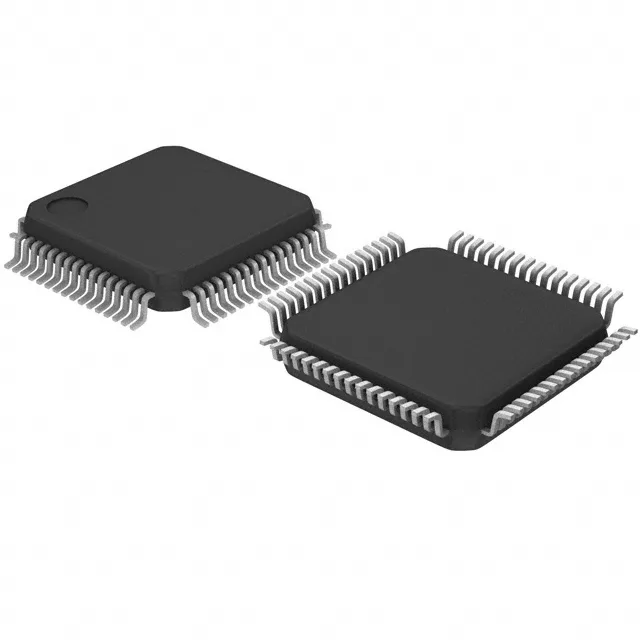
The 64-LQFP is a fine-pitch (0.5 mm) surface-mount package that reflows well with a standard profile.