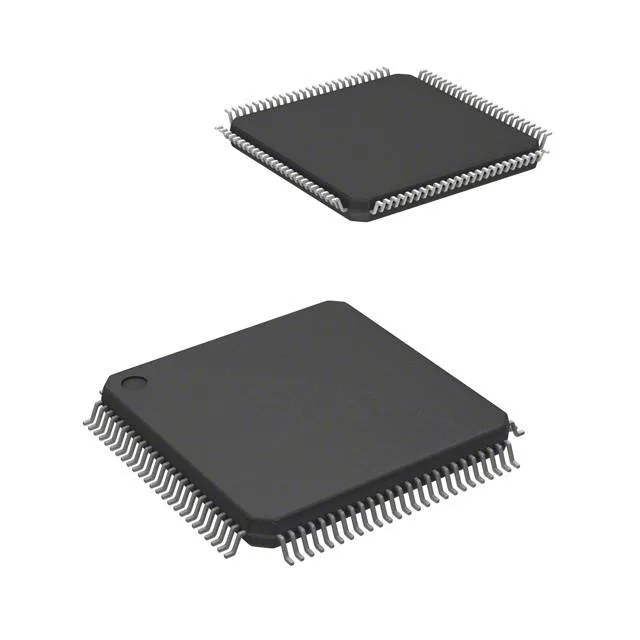
STMicroelectronics STM32F103VBT6TR — Microcontrollers & Processors (MCU / MPU / DSP)

STM32F103VBT6TR STM32F1 ARM Cortex-M3 MCU, 72 MHz

MPNSTM32F103VBT6TR
Active

STMicroelectronics STM32F1 series, ARM Cortex-M3, 32-Bit Single-Core MCU, 72 MHz, 128KB (128K x 8) FLASH, 20K x 8 RAM, 100-LQFP, -40°C to 85°C, 2V to 3.6V supply.

$8.4500Ref. price · indicative, final on quote
Packaging100-LQFP
RoHSROHS3 Compliant
SeriesSTM32F1
Independent supplier — new & surplus stockAuthenticity-screened · ESD-safe packingListing updated Aug 2026

Specifications

STM32F103VBT6TR specifications
ParameterValue
SeriesSTM32F1
MountingSurface Mount
Oscillator typeInternal
Program memory typeFLASH
Voltage - supply (Vcc (Vdd))2V ~ 3.6V
Operating temperature-40°C ~ 85°C (TA)
Speed72MHz
PackageTape & Reel (TR) Cut Tape (CT)
RAM size20K x 8
Core size32-Bit Single-Core
PeripheralsDMA, Motor Control PWM, PDR, POR, PVD, PWM, Temp Sensor, WDT
ConnectivityCANbus, I²C, IrDA, LINbus, SPI, UART/USART, USB
Number of i (O)80
Core processorARM® Cortex®-M3
Case100-LQFP
Data convertersA/D 16x12b
Program memory size128KB (128K x 8)

Product details

72 MHz Cortex-M3 with 128 KB Flash – the mid-density workhorse

The STM32F103VBT6TR: This MCU is part of the STM32F1 series, an ARM Cortex-M3 family. The 128 KB Flash is the mid-density option in the STM32F103 line — enough for a FreeRTOS image with a modest application layer, but not the multi-megabyte tier needed for GUI frame buffers or over-the-air staging on a full filesystem. The 20 KB SRAM supports a few moderate-sized buffers; designs that queue large CAN or USB payloads should budget the RAM allocation early.

Peripherals and connectivity set

On the peripheral side, this MCU includes DMA, a motor-control PWM timer, a temperature sensor, and a watchdog — the usual complement for a motor-drive or power-conversion controller. The 80 available I/O in the 100-LQFP package leave plenty of pins for parallel sensor arrays or a parallel LCD interface. The internal oscillator means a basic blink-and-ADC application can run without an external crystal, saving two pins and a few cents on the BOM. For USB or CAN operation, an external resonator or crystal is still recommended for clock accuracy.

The ROHS3 compliance is confirmed, which keeps it clear of the RoHS exemption phase-outs that affect some older STM32F1 date codes.

TR suffix – tape-and-reel vs tray

The silicon, firmware, and pinout are identical — the only difference is the shipping medium. If your pick-and-place line is set up for reel-fed 100-LQFP, the TR variant saves a manual tray-handling step. For prototyping or low-volume builds, the tray version may be more convenient, but both are electrically interchangeable.

Frequently asked questions

Where can I buy STM32F103VBT6TR available via RFQ confirmation?

This part is available to order through independent distribution. Submit an RFQ for current availability and pricing — stock levels and market price are confirmed at quote time.

What is the difference between STM32F103VBT6 and STM32F103VBT6TR?

The only difference is the shipping medium: the VBT6 ships in a tray, the VBT6TR ships in Tape & Reel. The silicon, firmware, pinout, and all electrical specifications are identical.

Can STM32F103VBT6TR be programmed with an ST-Link?

Yes, the STM32F103VBT6TR uses the standard ARM Serial Wire Debug (SWD) interface, which is supported by all ST-Link programmers (V2, V3, and clones). Connect SWDIO, SWCLK, GND, and 3.3 V.

How does this compare to the STM32L151CBU6A?

The STM32L151CBU6A is a lower-power Cortex-M3 variant running at 32 MHz with similar peripherals but less I/O (37 vs 80) and a smaller package. The STM32F103VBT6TR is the right choice when you need the full 72 MHz throughput, 80 I/O, and CAN/USB connectivity; the L151 is better for battery-powered designs where every microamp counts.