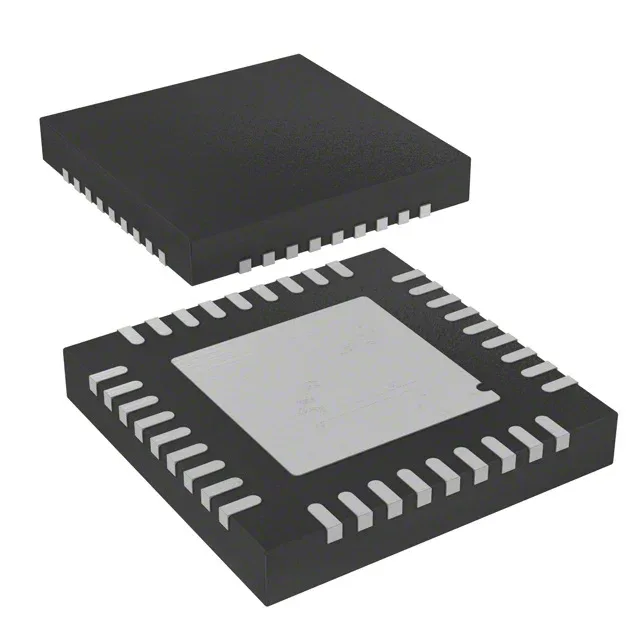
72 MHz ARM Cortex-M3 in a 6x6 mm VFQFPN
It belongs to the STM32F1 series, the most widely deployed Cortex-M3 family in industrial and consumer applications. Key on-chip peripherals include DMA, a motor control PWM timer, a 10-channel 12-bit ADC, and a CANbus interface alongside USB, SPI, I²C, and multiple UART/USART channels. The supply voltage range of 2V to 3.6V allows direct operation from a single Li-ion cell or a regulated 3.3V rail without an external LDO.
Industrial temperature grade and deployment fit
The 105°C upper limit provides headroom above the more common 85°C industrial grade, which matters when the part sits near a power stage or in a sealed housing with limited airflow. Without those vias, junction temperature rises faster under continuous load — something to account for in the layout review if the MCU drives multiple outputs or runs the ADC continuously.
The STM32F1 series has been in production for over a decade and has a mature ecosystem of tools, middleware, and application notes. While the series is not being actively expanded with new variants, the existing portfolio — including this 128 KB density option — remains in active manufacture for the industrial and automotive aftermarket.
For dual-sourcing consideration, the STM32L151CBU6A is a functionally similar Cortex-M3 alternative with lower power draw and a 32 MHz core, but it is not pin-compatible — it uses a different package and I/O count. The 26 I/O lines in a 36-pin package mean several pins serve dual functions. If your design needs all 10 ADC channels plus CAN and USB simultaneously, verify the pin multiplexing against your peripheral allocation during schematic capture — the STM32F1 reference manual covers the alternate function mapping.