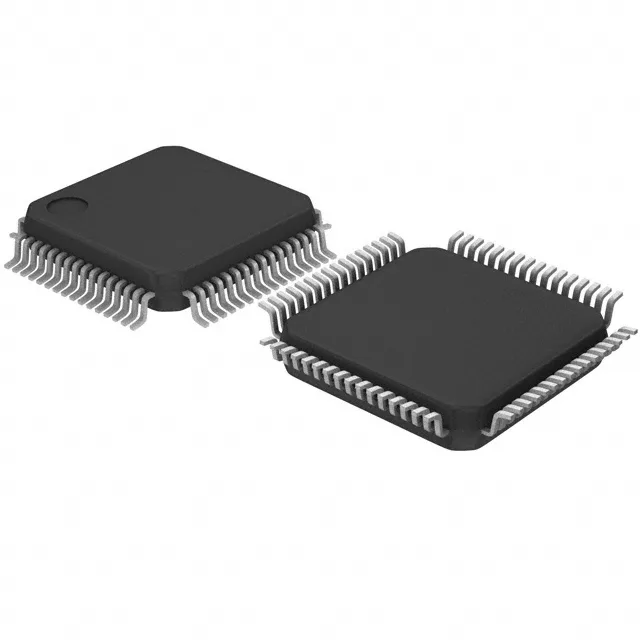
72 MHz Cortex-M3 with 128 KB Flash — the mainstream workhorse
It is the tape-and-reel variant of the widely used STM32F103RBT6, sharing the same die and 64-LQFP footprint but shipped in Cut Tape or Tape & Reel for automated pick-and-place assembly. This part sits in the STM32F1 series — the original STM32 line that defined the mainstream 32-bit MCU market — and is built for applications needing a balance of compute throughput, peripheral integration, and supply simplicity on a single 2V to 3.6V rail. Key on-chip peripherals include DMA, motor-control PWM timers, a 16-channel 12-bit ADC, and connectivity for CANbus, USB, SPI, I²C, and multiple UART/USART interfaces.
At 72 MHz, the Cortex-M3 executes single-cycle multiply and hardware divide, giving it enough headroom for sensor fusion, field-oriented motor control (FOC) with the integrated PWM timers, or protocol stacks like CANopen and USB HID without a co-processor. The 20 KB SRAM is sized for moderate data buffers — a 1 KB CAN message queue plus a 4 KB USB descriptor pool leaves room for stack and variables.
51 I/O and 16-channel ADC — analog and digital density
The 16-channel 12-bit ADC samples at up to 1 µs conversion time, enough for six current-sense resistors in a three-phase motor drive plus a thermistor and a potentiometer — no external multiplexer needed.
Tape & Reel vs. tray — the only difference from STM32F103RBT6
The STM32F103RBT6TR is electrically and mechanically identical to the base STM32F103RBT6. The 'TR' suffix indicates it is supplied in Tape & Reel (and also Cut Tape) packaging rather than tray. The die, firmware, and all parametric ratings are the same.