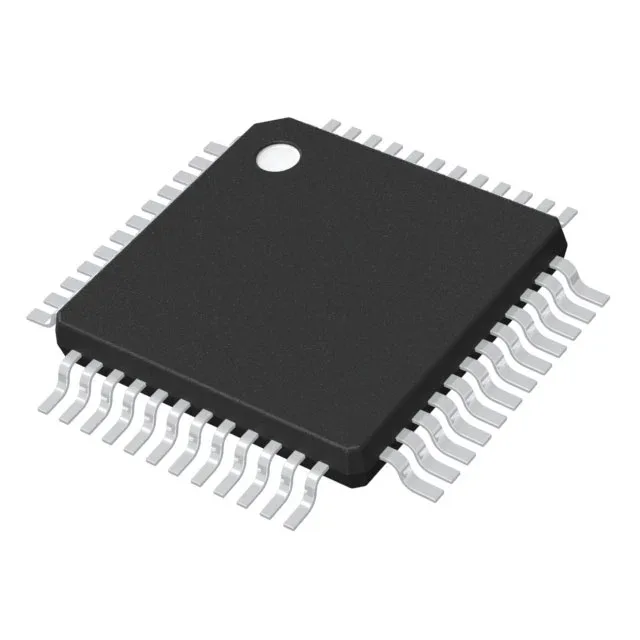
On-chip data converters include a 10-channel 12-bit ADC. Typical applications span motor drives, industrial control, sensor nodes, and human-machine interfaces where the combination of CAN and USB on a single chip reduces external bridge ICs.
Memory and peripheral fit for a control-oriented design
128 KB of Flash and 20 KB of RAM (organized as 20K x 8) is the mid-density tier in the STM32F103 line. For a typical motor-control firmware stack with a CANopen stack, a USB CDC class, and a few PID loops, this leaves comfortable headroom — you are not forced into the next density step unless you need a full GUI framebuffer or over-the-air update staging in RAM. The 72 MHz Cortex-M3 core runs single-cycle multiply and hardware divide, which keeps control-loop jitter low without a dedicated DSP. The 37 I/Os in the 48-pin LQFP give enough GPIO for a keypad, encoder inputs, and a small TFT parallel interface without bit-banging.
Internal oscillator means a basic design can boot without an external crystal for UART and GPIO tasks, though USB requires the external 8 MHz resonator for accurate bit timing.
For existing production, the active status means no forced redesign cycle.