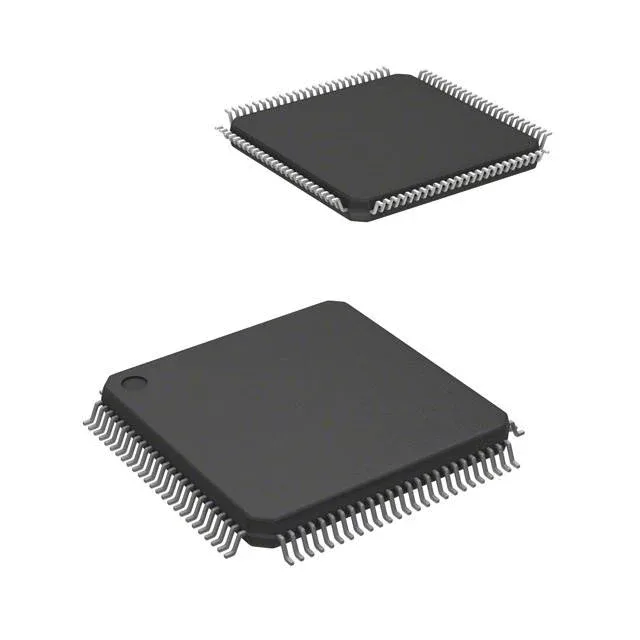
This is the cost-optimised sibling in the family — the same core and peripheral set as the STM32F103, but with the clock halved and no USB or CAN interface. It targets control applications where the full 72 MHz and the extra connectivity of the F103 would be overkill: motor commutation, sensor fusion, industrial I/O modules, and human-machine interfaces that don't need a high-speed bus.
128 KB Flash, 16 KB SRAM – sizing the firmware budget
Program memory is 128 KB of Flash, organised as 128 K x 8. The 16 KB SRAM (16 K x 8) is modest by today's standards — enough for a real-time OS with a few tasks, a small frame buffer, or a modest data logger. If your application needs more than a few kilobytes of heap or a large lookup table, you'll be sizing the external memory interface or stepping up to the STM32F103 with its 20 KB SRAM and 72 MHz clock.
The internal oscillator means you can skip the external crystal for non-timing-critical applications, though the 36 MHz PLL still needs a clean supply.