Entry-level 32-bit MCU for cost-sensitive control
It targets simple control tasks — sensor readout, relay sequencing, basic motor commutation — where the full 72 MHz performance of the F103 would be overkill.
At 36 MHz, this part runs at half the clock speed of the STM32F103. That is fine for polling a few sensors over SPI or managing a UART-based display, but it will not sustain heavy DSP or real-time control loops with tight timing margins. The Cortex-M3 core still gives you single-cycle multiply and hardware divide, so basic math does not stall the pipeline.
16 KB of program memory fills fast once you add a HAL, a scheduler, and communication stacks. Plan for lean firmware — no RTOS if you can avoid it, and watch the linker map. The 4 KB SRAM is enough for a couple of 512-byte buffers and a modest call stack, but not for large data arrays or frame buffers. If your application needs more headroom, look at the STM32F101R8 (64 KB Flash) or step up to the F103 line.
Active lifecycle — no end-of-line pressure
ST lists this part as Active.
Peripherals and I/O for basic system integration
The 26 I/O lines include standard serial interfaces: I²C, SPI, and two UARTs (with IrDA and LIN support). There is also a 10-channel 12-bit ADC, DMA controller, and a temperature sensor built in. No CAN or USB on this variant — if you need those, the STM32F103 or STM32F105 families add them.
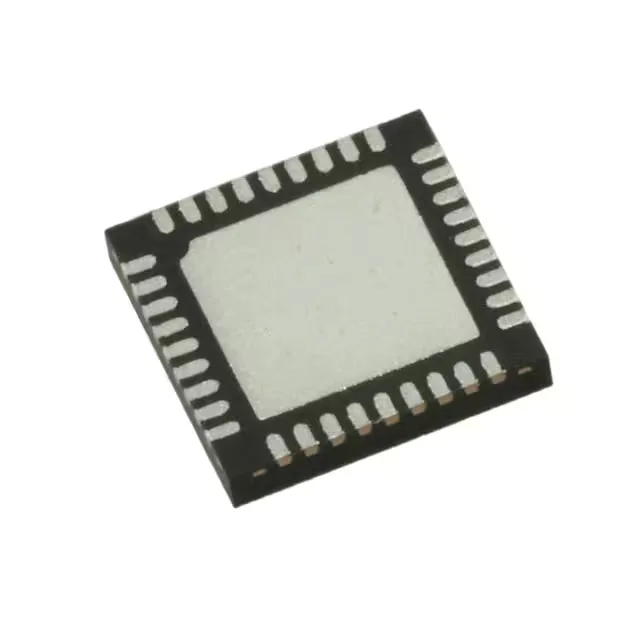
The 36-VFQFPN (6x6 mm) is a QFN with an exposed thermal pad. It needs a reflow profile, not a soldering iron — do not try to hand-solder this on site without a hot-air station. The pad must be stitched to a ground plane with thermal vias to pull heat away; without that, junction temperature climbs fast above 400 mA continuous draw.