Value-line Cortex-M3 for cost-sensitive control
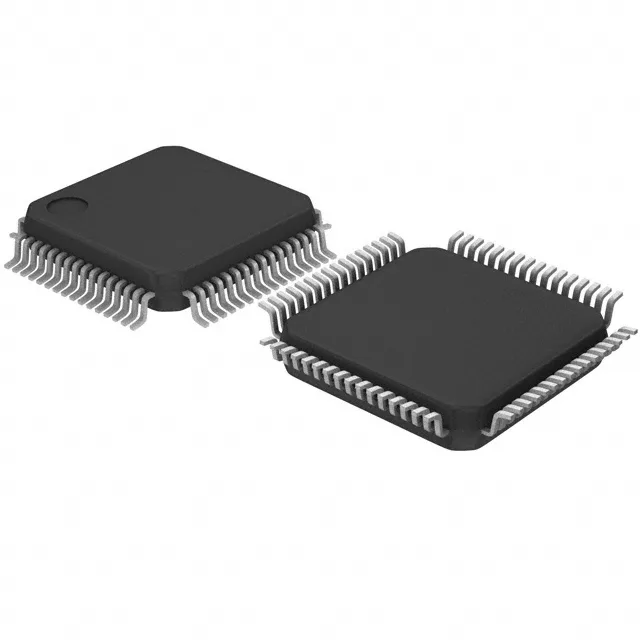
The STM32F101R4T6A: It is designed for cost-constrained embedded control applications — motor-control feedback loops, sensor hubs, and serial-bridge nodes in industrial or building-automation gear. The 64-LQFP package gives access to 51 GPIOs, and the on-chip DMA engine keeps data moving without loading the core.
The 36 MHz core speed is half the 72 MHz of the STM32F103 sibling, which directly limits instruction throughput and PWM update rates. For a 3-phase motor drive running a 20 kHz PWM with dead-time insertion, the 36 MHz part still has headroom for the control loop and commutation logic. But if your application needs heavy floating-point math or high-rate ADC sampling (the on-chip ADC is 12-bit, 16-channel), the lower clock means longer sample-and-conversion windows — budget your ISR cycle count accordingly.
Memory budget — 16 KB Flash, 4 KB SRAM
With 16 KB of program Flash and 4 KB of SRAM, this is a tight-memory part. The Flash holds a modest firmware image — a bootloader plus a single application layer — but leaves no room for over-the-air update staging or large lookup tables. The 4 KB SRAM handles a few hundred bytes of stack plus a couple of moderate-size buffers.
Peripheral set — serial interfaces and analog
On-chip peripherals also cover DMA, a temperature sensor, power-on reset (POR), programmable voltage detector (PVD), and a watchdog timer. Missing are USB, CAN, and a second ADC — so if your BOM calls for USB device connectivity or a CAN transceiver interface, this is not the part.
It remains a safe production choice for new designs. The ROHS3 compliance is standard for current European and Asian assembly lines.