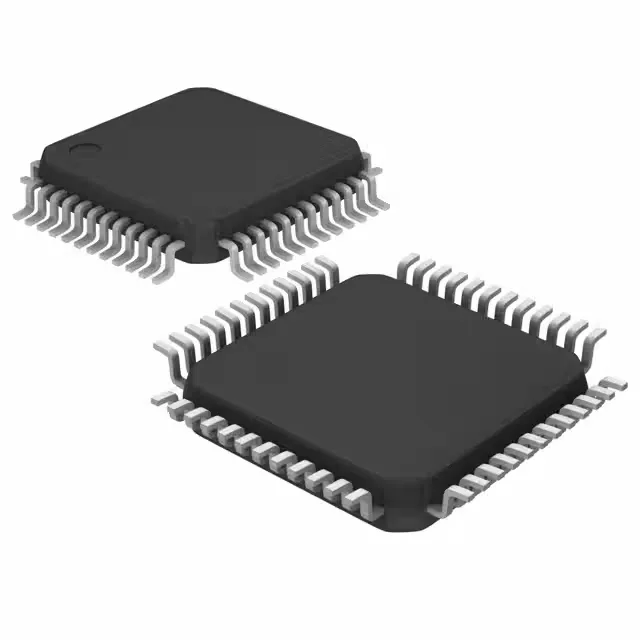
The 36 MHz clock is the ceiling for the Cortex-M3 pipeline. At this speed, single-cycle multiply and hardware divide keep interrupt latency low. For control loops — say, a 10 kHz PID with sensor reads and PWM updates — you stay well under 50% CPU load. If your application needs faster math or higher update rates, the STM32F103 sibling runs at 72 MHz with the same pinout.
128 KB Flash, 16 KB SRAM — sizing the firmware budget
128 KB of program Flash and 16 KB of SRAM define the application envelope. That Flash fits a moderate RTOS kernel plus a TCP/IP stack and application code; the SRAM handles a few KB of stack, heap, and DMA buffers. If your firmware needs OTA staging or data logging, budget the Flash accordingly — there is no external memory interface on this package variant.
Industrial temperature range and on-chip peripherals
It includes a temperature sensor, POR/PDR/PVD, a watchdog timer, and a DMA controller — enough to run standalone without an external supervisor in most factory and outdoor equipment. The 10-channel 12-bit ADC samples at up to 1 µs, adequate for reading analog sensors like thermistors or current shunts.